

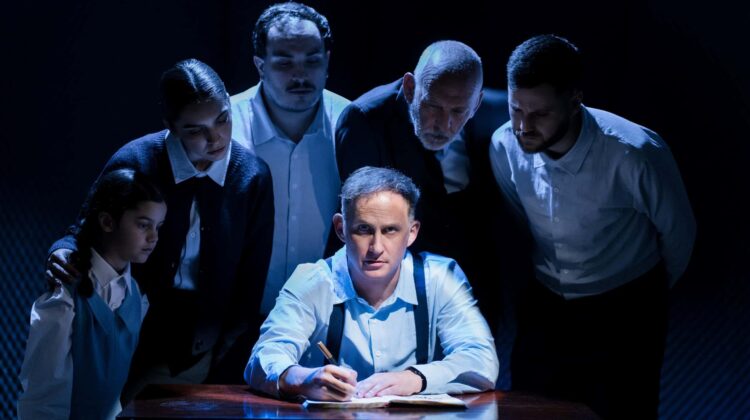
Robert Icke and Duncan Macmillan’s adaptation of George Orwell’s 1984 is currently running at Teatru Manoel as part of the Toi Toi Classics programme. Currently, global theatre is very much staging a significant return to political drama, In New York we’ve seen classics like An Enemy of the People and Cabaret alongside new material like Suffs. In London we’ve seen January 6th Reimagined, The Unseen, and Best of Enemies among others.
In Malta, too, theatre is riding this wave of political consciousness, with works like Press Mute (focusing on the erosion of journalism, Blanket Ban (tackling Malta’s abortion ban) and, previously, Naħliflek (a feminist retelling of Artemisia Gentileschi’s life).
It’s edifying to see the national theatre’s programming play a leading role in presenting strong, politically-grounded pieces. Earlier this season we also saw a dismayingly relevant production of A View from the Bridge. Ronbert Icke’s and Duncan Macmillan’s 1984 comes as we head into week two of the Trumpian nightmare that’s currently unfolding across the Middle East, Europe and the United States. Before heading into the actual review, here are the details.
Table of Contents
| Play | 1984 |
| My Rating | ⭐⭐⭐⭐ (4 out of 5) |
| Producer | Teatru Manoel, as part of the Toi Toi Classics |
| Director | Petra Sant |
| Cast | Edward Caruana Galizia, Tina Rizzo, Alan Paris, Stephen Oliver, Alex Weenink, Brandon Thearle, Nicholas Jackman, Carla Abela, Naomi Scicluna |
| Venue | Teatru Manoel |
| Dates | March 6, 7, 8, 14, 15 |
| Duration | 1 hour 40 minutes, no interval |
| Trigger warnings | Flashing lights, torture scenes, sexual references |
Teatru Manoel’s 1984: The Narrative
Robert Icke and Duncan Macmillan’s adaptation is largely faithful to the George Orwell original. The key themes are thankfully untouched, as the story follows the gradual unravelling of protagonist of sorts Winston Smith. Winston is a low-ranking member of the all-powerful ruling party that’s headed by Big Brother. In this dystopian climate, dissenting actions and thoughts are banned, Big Brother watches everything you do via monitors, and even sex is a political act. Now what on earth is this reminding me of?
Winston starts an affair with Julia, the two are seduced by a party apparatchik disguised as a rebel, and everything goes belly up. It’s a very simplistic summary, but if you haven’t read the book it hits all the high notes. The script is punctuated by all the classic Orwellian horrors, from the Thought Police (making anti-state thoughts a crime) to the Memory Hole (where dissenters are literally deleted, along with inconvenient parts of history), the Two Minutes of Hate (which are exactly what they sound like), and Room 101 (torture and execution).
One huge departure from the original is the way the playwrights integrate the concept of Newspeak within the main narrative. In the book, Newspeak is a fictional dictionary that Orwell presents as an appendix to the book, essentially a party-created language where any words that can be used to show dissent are removed from use. Thus, vocabulary is constantly diminishing, with the formulation of any sort of disagreement or rational argument becoming impossible.
The control of language as a means of controlling freedom of expression is a recurring device even in more modern works, like Mark Dunn’s Ella Minnow Pea. Ick’s and Macmillan’s adaptation introduces the new language immediately at the start of the play, where we meet a group of academics from the future debating the authenticity of Winston’s diary. These interludes effectively link the narrative’s past, present and future while casting an almost sinister doubt on whether the events are historical or fictional.
The adaptation works, efficiently hammering home the political nightmare created by Orwell in a way that’s very chillingly relevant. Given that the world’s largest political force is now “ruled” by a party that believes in alternate facts, phrases like the Memory Hole take on new meaning.
1984: The cast
Edward Caruana Galizia gives us a Winston that’s strong and weak; admirable,and pathetic, in equal measures. His is an excellent portrayal of a man who starts out strong in his convictions, but by the end is reduced to a trembling wreck who – under torture – barely hesitates to betray everything he believes in. Caruana Galizia’s portrayal is consistently solid. The actor has a good track-record in nuanced character-building, his role in Masquerade’s Betrayal being a case in point. Here, too, he holds the audience’s attention at all times.
The role of Julia is played by Tina Rizzo, who delivers an assured performance, commanding the stage without overplaying physicality or emotions. I particularly appreciated Rizzo’s emotional layering of a very complex character, creating a sense of danger that played well with the erotic and the tender moments. Rizzo’s talent in nuance matches that of Caruana Galizia, the one strongest recent example I can think of being the bi-lingual Pip in Sisyphean Quick Fix.
The wider cast also delivers strong performances, sustaining the production’s tension and helping to give its world texture and credibility.
1984: Direction and staging
This is Petra Sant’s proper directorial debut, although she’s helmed a number of junior theatre productions for Masquerade. Teatru Manoel’s 1984 is a complex play that presents many potential pitfalls for an inexperienced director, but Sant navigates these credibly, giving us a well-paced production and displaying more confidence and control than one might expect from a first-time director. Her use of the space is particularly effective, especially when the side aisles become part of the performance space during the Two Minutes of Hate.
Transitions between past, present and future could have been handled better; there just isn’t sufficient contrast. This results in brief moments of confusion. A subtle shift in lighting tone, in the manner of Better Call Saul, could have created a better transition between time periods.
Adrian Mamo’s set design creates a retro-futuristic hell with the infamous Big Brother Is Watching You screen a constant, oppressive presence. The multi-level layout defines the different spaces and the registers of the action. Lighting by Gianluca Bianco, as well as sound design by Sergio Costa and visuals by Dylan Odom (both fresh from Noti Mil-Loki Tal-Big G’s) build on the tension, occasionally shocking into a state of unease and disorientation.
1984: The verdict
Teatru Manoel’s 1984 is an ambitious and well-executed production. Sant delivers an intelligently staged and unsettling piece of theatre that captures the impact of the source material. Cast chemistry, technical skill, and the unnerving immediacy of its themes make this a production well-worth watching.
Affiliate/Advertising Disclaimer: How I Carry Out Reviews
I received no payment for this 1984 review and I was offered press tickets. The opinions expressed here are purely my own and the producers had no input/control over what I wrote. There are no affiliate links contained within this page. To learn more about my policies and my reviewing process, visit my Affiliate/Advertising disclosure page. To better understand what my rating means, check out the details of the star system.