
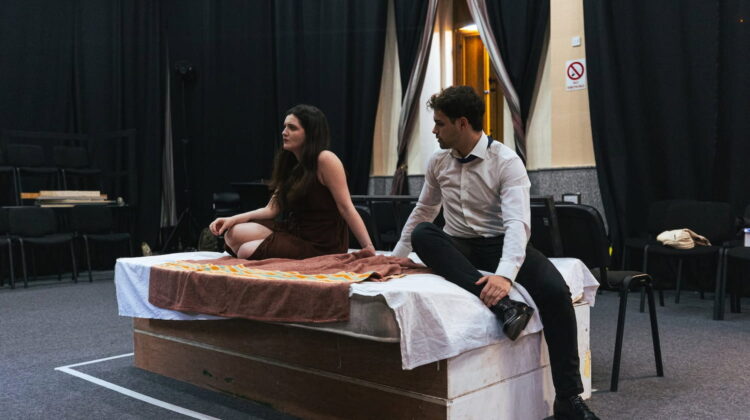
Djalogu Bejn Qaħba u L-Klijent Tagħha. Photo: Facebook / Teatru Malta
Dacia Maraini’s Dialogo di una prostituta col suo cliente was recently performed as part of Teatru Malta’s Għaxra cycle, in a translation by Albert Marshall. Djalogu Bejn Qaħba u L-Klijent Tagħha is a wonderfully provocative play, with dialogue and scenes that are thought-provoking, relevant and – yes- will still shock.
Unfortunately, there were too many shortcomings within the production itself, and not even Marshall’s exquisite translation could save it. Before diving into the review, here are the details.
Djalogu Bejn Qaħba u L-Klijent Tagħha – details
| Play | Djalogu Bejn Qaħba u L-Klijent Tagħha |
| My Rating | ⭐⭐🌟 (2.5/5) |
| Producers | Teatru Malta |
| Script | Dacia Maraini |
| Translation | Albert Marshall |
| Director | Julia Camilleri |
| Għaxra Artistic Director | Philip Leone-Ganado |
| Cast | Marjann Attard, Matthew Dimech Genuis |
| Production Manager | Sara Gauci |
| Stage Manager | Luca Xerri |
| Technical Director | Gianluca Bianco |
| Content Warnings | Sex, violence, language |
| Running Time | 1 hour 30 mins |
| Venue | Teatru Domus |
| Language | Maltese |
Djalogu Bejn Qaħba u L-Klijent Tagħha – narrative and translation
Djalogu Bejn Qaħba u L-Klijent Tagħha is not an easy play. Not to direct, act, or even watch. The script is a very intense two-hander that sees the prostitute of the title engage in extremely fast conversation with her client. And, on occasion, with the audience. Despite being written over 50 years ago, it addresses themes that remain eminently relevant thanks to the subversive reversal of the power dynamics in the relationship between sex workers and their male clients.
This is a no-holds barred descent into the psyche of human sexuality, a witty analysis of the urges that drive the heterosexual male, and how these contribute to the everturning wheel that keeps the patriarchy going nice and strong. The original text is unflinchingly explicit and the Maltese language, with its immediacy and force, leaves little room for euphemism. Yet, Marshall’s translation never resorts to shock for its own sake. It preserves the integrity of Maraini’s language while uncovering an unexpected poetry within its rawness.
The abrasiveness is ever-present, a necessary quality in a work that confronts exploitation, violence and unequal power without softening their impact. Marshall’s translation is blunt, intentionally so. It keeps the exchange uncomfortable enough that the realities the characters are navigating are never forgotten, even throughout the occasional flashes of tenderness. Because, as improbable as it may sound, this script is as tender as it is confrontational, and Marshall fully succeeds in capturing the contrasting nuances that make the original so notable.
Marshall skilfully strips the sexual encounter of fantasy and renders it almost clinical, exposing it as something to be examined and interrogated. Desire, power, money and vulnerability are laid bare with analytical precision, forcing us to confront the mechanisms behind the exchange.
This is the second script translation I’ve reviewed as part of the Għaxra cycle (the other was 5Subien.com), and in both cases the results are truly solid. That said, I would also have liked to see a female translator leave her mark on this feminist piece.
Direction and staging
Director Julia Camilleri faced an undoubtedly difficult task, and the production struggled to capture the complexity and tension of the script. One bed dominates the minimalist stage. But, beyond establishing the setting, it offers the direction relatively little to work with, its scale restricting movement. The stage feels static even when the script asks for shifts in distance.
The pacing is uneven, with exchanges that required tight confrontation sometimes drifting. This had the effect of flattening the script’s movement between aggression, tenderness and fear.
Ironically, the production’s biggest strength is found in arguably the toughest scenes – the sexual sequences themselves. Here, Camilleri opts for creative visual language, with the bedclothes becoming an extension of the body and used to effective dramatic purpose.
Cast
Djalogu Bejn Qaħba u l-Klijent Tagħha is exceptionally demanding material. Marjann Attard and Matthew Dimech Genuis both approach the material with commitment, albeit with an uneven result. More experienced performers might have brought greater nuance to the script’s complex shifts in power and vulnerability.
Of the two, Marjann Attard delivers a more assured delivery, despite that hers is arguably the more demanding role. She is particularly effective in the passage describing the different penises she has encountered, finding a rhythm and confidence that allow the comedy, bluntness and underlying weariness of the text to come across. Her direct interaction with the audience, however, is less convincing and felt performed at them rather than shared with them.
Matthew Dimech Genuis is less consistent, with several lines lost or insufficiently projected, particularly at moments of heightened dramatic tension. Some scripts can forgive it, but not this one. The emotional force of the exchange depends on each line landing clearly. When it doesn’t, the impact is weakened and the audience struggles to follow the shifting stakes.
Verdict
Djalogu Bejn Qaħba u l-Klijent Tagħha benefits from a formidable original text and Maltese translation, but the production around them never acquires the precision or dramatic control they deserve. There are flashes of effective theatrical thinking, particularly in the sexual sequences, but too much of the tension is lost through static staging, uneven pacing and inconsistent delivery.
Which isn’t to say that the potential is not present. Perhaps, a touch more guidance – along the lines of the mentorship given throughout Teatru Malta’s recent Ġimgħa l-Ħabs – may have served the production better.
Affiliate/Advertising Disclaimer: How I Carry Out Reviews
I received no payment for this review of Djalogu Bejn Qaħba u l-Klijent Tagħha, and I was offered press tickets. The opinions expressed here are purely my own and the producers had no input/control over what I wrote. There are no affiliate links contained within this page. To learn more about my policies and my reviewing process, visit my Affiliate/Advertising disclosure page. To better understand what my rating means, check out the details of the star system. Check out my latest writeup: Cagliostro & The Pirate Queen: The Secret Story of Malta.