
This new script by Simone Spiteri, Ħobżna ta’ Kuljum is inspired by the 1977 bread strike but, given some of the themes it tackles, it could just as easily have been taking place in 2026. You don’t need to know the historical background to enjoy this play: the narrative revolves around the lives of a conventional working-class family of the era, and it’s almost too painfully familiar.
The production’s many strengths include a solid cast, superb direction and gorgeous staging. But before getting into the full review, here are all the practical details for Dù Theatre’s Ħobżna ta’ Kuljum.
Table of Contents
Ħobżna ta’ Kuljum details
| Play | Ħobżna ta’ Kuljum |
| My Rating | ⭐⭐⭐ ⭐ ⭐ (5/5) |
| Producer | Dù Theatre |
| Script | Simone Spiteri |
| Director | Simone Spiteri |
| Cast | Daniela Carabott Pawley, Mary Rose Mallia, Lino Mintoff, Magdalena van Kuilenberg, Krisjana Casha, Rachel Pecorella Genovese, Matthew Dimech Genuis, Thomas Camilleri |
| Stage Manager | Franica Pulis |
| Light design | Moritz Zavan Stoeckle |
| Music composition | Luke Saydon |
| Sound design | Matteo Depares |
| Set design | Romualdo Moretti |
| Content warnings | Strong language, sexual references, suicide |
| Running Time | 2.5 hours including interval |
| Dates | September 18, 19, 20, 21, 24, 25, 26, 27 |
| Venue | Valletta University Campus |
| Language | Maltese, English surtitles on the 24 & 27 |
Ħobżna ta’ Kuljum – narrative
Ħobżna ta’ Kuljum is written by Simone Spiteri, who has literally never given us a dud, so my expectations were very high. Most recently you will remember me waxing lyrical about her translation of Paula Vogel’s work, Kif Tgħallimt Insuq, which inserts the horrifying topic of sexual abuse into ordinary family dynamics to chilling effect.
With Ħobżna ta’ Kuljum, Spiteri showcases her mastery of language, plot and characterisation. We are once again introduced to a seemingly ordinary family who’s just trying to cope with the hardships of working class life in 20th-century Malta, but with the added complication of a bread shortage.
It’s all painfully normal on the surface, as we’re introduced to the pater familias – a word that carried a multitude of meaning in the era – alongside his wife, three daughters and son. Spiteri’s narrative presents the most mundane of tableaux, from complicated dynamics among siblings, spouses and extended family to the obligatory adulation of Il-Perit (which is how many referred to then-Prime Minister Dom Mintoff, just in case you weren’t around at the time).
Alongside this snapshot of daily working life, kitchen drudgery, petty politics and romantic relationships, Spiteri inserts an insidious undercurrent of darkness that gradually becomes cloying. As audience we feel it instantly, but we can’t quite put our finger on it.
The script occasionally departs from the main narrative to reference other historical events, each connected to the vital role bread played in the life of the ordinary Maltese person, each a tragic consequence of oppression. The effect of these short asides is cumulative, as they continue to dial up the tension. With superb skill, Spiteri keeps us on the edge of our seats, wondering what is going to happen and when.
When the sword falls, it’s devastating and we ask ourselves how we didn’t see this coming. I will stop here and let you discover the actual details for yourself. But I will say this – Ħobżna ta’ Kuljum is a feminist play, but it’s also a play that poignantly depicts the ills of oppression in general, whether it arises from gender, class, or sexual orientation.
The cast
No weak links here as some very established and beloved names join emerging ones for a uniformly strong performance. Daniela Carabott Pawley delivers a formidable Rita, the protagonist who finds out that she wants more from life than getting married and breeding, which is the immutable formula of the day if you’re a woman.
Carabott Pawley never fails to give even a smaller role a dinstinct character of its own. In MADC’s staging of King Lear last year, she was one of the biggest highlights in the role of Regan. In Ħobżna ta’ Kuljum she painfully conveys the inner turmoil of a mind and soul that yearns for new experiences, and a career that doesn’t involve cleaning. Hers is a layered performance, with suffering expressed through measured dialogue, deliberate facial expressions and even through the way she carries herself. There’s no wailing and gnashing of teeth, which makes her one confrontational outburst cut deeper.
It was a joy to see Mary-Rose Mallia on stage again as Rita’s mother, Mary. Mallia delivers a bittersweet contrast between the tribulations of raising four children and a husband when money is scarce, and the dry Maltese humour she truly excels at.
She nails the stereotype of the Maltese woman of the time without turning it into a cliché, her obsession with the bread shortage hiding a more disturbing undercurrent to her personality even as the rest of the family ridicules her for it. Lino Mintoff is credible as Joey, the father who ultimately brings the entire house of cards crashing down.
Magdalena van Kuilenburg (Aunt Bice) and Rachel Pecorella Genovese, (Tania) bring emotional weight, in different ways, to the expectations placed upon women. The monologue where van Kuilenburg likens a woman to a loaf of bread is particularly harrowing. On the other hand, Pecorella Genovese captures the desperation of a woman who, on the surface has the life her elder sister covets, but in reality is trapped by the demands of her husband and a continuous stream of pregnancies.
Matthew Dimech Genuis’ Walter is a welcome burst of comic energy to the production, using cheeky colloquialisms, nimbleness and well-judged timing to capture the swagger of the younger son who knows he can get away with anything. Literally, as we get to learn when the narrative progresses to the second act. The role reveals Dimech Genuis to be a more assured and well-rounded performer than his recent turn in Djalogu Bejn Qaħba u l-Klijent Tagħha would have suggested, with greater command of language, timing and physicality. It will be interesting to see what he does next.
Direction, staging & music
Ħobżna ta’ Kuljum is directed by Simone Spiteri. I’m not always a fan of combining the role of writer and director, as there have been too many instances when the production suffers from a lack of critical distance. I didn’t expect this to be a problem for Spiteri, and I wasn’t disappointed as the director brings her script to life in a tightly controlled, visually fluid production.
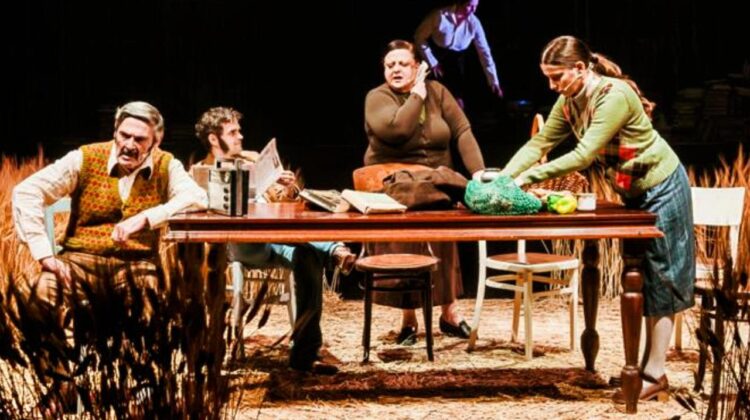
Romualdo Moretti’s stage is gorgeous, with the lower-front dominated by a realistic field of wheat that dances in the breeze – sometimes merrily, at others eerily. Of course, it’s not just about looking good. The split-level allows the action to move constantly between foreground and background without interrupting the flow. At times, one part of the stage freezes while another remains active, creating a layered visual language that adds depth to the storytelling. This is all beautifully complemented by Luke Saydon’s music, which underscores the shifting emotions of the piece without overwhelming them.
The only fly in the ointment when I attended was the sound, and it almost cost Ħobżna ta’ Kuljum the 5 star rating. During opening night the mics failed multiple times and produced crackling static. There was also an imbalance in the sound mix, with the dialogue often having to compete with radio music or the news broadcasts running in the background. That said, everything else was perfect. And I’m not one to throw that word around lightly.
Ħobżna ta’ Kuljum – verdict
No surprises when I say this is a must-see, if you manage to get tickets, that is. Only a handful are available at the time of writing. Ħobżna ta’ Kuljum tackles heavy themes – we’ve got the patriarchy, classism, the persecution of those who aren’t hetero-normative, colonialism. It’s a mystery how Simone Spiteri pulls this off without over-burdening the narrative, but pull it off she does. At no point does the play favour the message over plot and characterisation, and its point lands all the better for this restraint.
I’d love to say that Ħobżna ta’ Kuljum is an accurate depication of the time during which its set, but in reality it may as well have been set in current times for all the things that have (not) changed. You’ll get it when you watch the play, so do so.
Affiliate/Advertising Disclaimer: How I Carry Out Reviews
I received no payment for this review of Ħobżna ta’ Kuljum and I was offered press tickets. The opinions expressed here are purely my own and the producers had no input/control over what I wrote. There are no affiliate links contained within this page. To learn more about my policies and my reviewing process, visit my Affiliate/Advertising disclosure page. To better understand what my rating means, check out the details of the star system. For coverage of more light-hearted theatre, check out my writeup about Cagliostro & The Pirate Queen: The Secret Story of Malta.