


Last Updated on December 22, 2025 by Ramona Depares
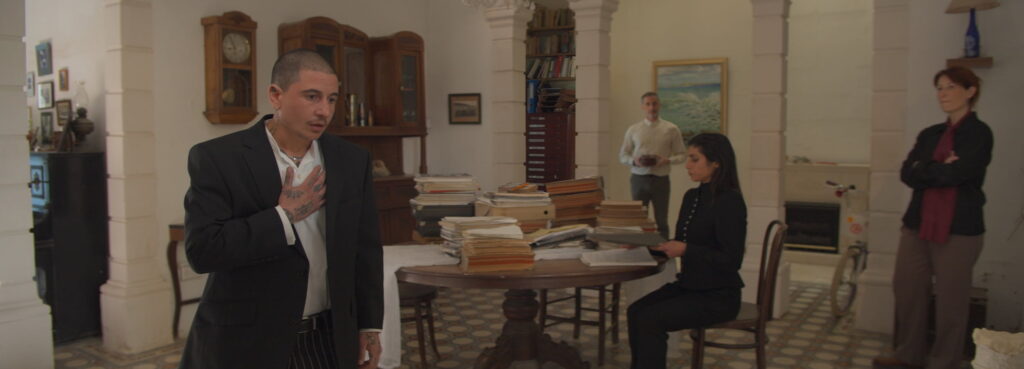
Photos: Still from video installation by Samira Damato and Teodor Reljić.
An upcoming video installation and publication by Samira Damato and Teodor Reljić, The Pity Party explores grief, death, tradition, and the strange intimacy of the online world. The work is born from real digital conversations between the artists as they each faced the loss of their fathers, blurring the line between memory, technology, and imagination. I caught up with them ahead of their opening on Saturday.
This project opens up your most intimate vulnerabilities to the world – do you view this as closure/catharsis? How do you cope with reopening the pain?
Teodor: Closure would not be the right word. Perhaps catharsis comes somewhat closer, though even that is fraught with contradictions, inaccuracies and superficial expectations that come with what is essentially an overused and over-applied word, I think. But the fact of being driven to do something, anything, in the wake of such a rupture always contains at least the sliver of a redemptive element – that’s the hope, anyway. And while cooling the grief in any real way is often a fool’s errand, I think that what Samira and I were trying to do with this project, more than anything, was rediscover our own agency in the wake of the deaths of our fathers. That simple starting point of being able to grieve independently, which everyone assumes is an easily available prerogative to the griever. But, in actual fact, is not always the case. Hence, ‘The Pity Party’ – in the sense of, the very title itself being both tongue-in-cheek and very earnest: it’s us carving out a space for ourselves in a wound that is already very much carved out.
Samira: I’ve come to realise that there is no such thing as closure or catharsis when it comes to grief. Grief doesn’t end; instead, we learn to reshape ourselves around its presence. Death and mourning are fundamental parts of life, yet our contemporary traditions have grown so distant from them that we often shut death out entirely. In doing so, we’ve forgotten how to speak about it at all.
The Pity Party is conceived as a reflection on what I see as a contemporary culture of grieving; on the rituals, gestures, and performances that accompany loss. It questions whether these practices should be reconsidered, and whether, in over-ritualising grief, we may have made an already difficult experience more painful.
Of course, there are many vulnerabilities in making, especially in creating a work like this. What I can reflect on is that the video pieces were filmed in my family home: the house I grew up in with my father, and where he passed away. The work itself adopts a processional form, taking from the funeral procession. It invites the viewer to walk along this journey (from screen to screen). Across these landscapes, the incredible, expansive, and overshadowing presence of nature makes painstakingly clear the smallness of decorum in the face of a greater, truer state of life and being. In this sense, the work becomes a critique of how ritual can sometimes act as a veil, masking the vastness of nature and existence itself.
The loss of both your fathers became ‘public property’ without consent. How did you feel about this, and did it impact the process and concept of the video? Is this a way of reclaiming your grieving process?
Teodor: Yes, and I’m sure Samira will agree that even though both our fathers were ‘public figures’ to some, though varying degrees, we were both struck and somewhat shocked by the way the intrusion of the public into our grieving process panned out – and this applies to both the wider circle of friends and acquaintances as well as certain family members. This is also part of the reason why we opted to use our WhatsApp chats – raw, earnest and unfiltered – and distill them into a video installation populated by grotesque and over-the-top characters. Some of these characters are uttering lines told to us verbatim; these come across as jolting and inappropriate (even to a shocking degree), both in and out of context. This isn’t about us ‘settling scores’, but really about exploring the response and reaction people have towards death. If there is a wider ‘critique’ at the core of the work, I believe it’s about how our contemporary culture leaves little space for healthily prolonged and dignified grieving. Instead, it nudges everyone towards dovetailing into either denial or hackneyed rituals and reactions that do more harm than good.
Samira: My father, Mario Damato, grew up in Paola and died in Birżebbuġa, and served as Director of Greenpeace East Asia. I was confronted with this idea of a loved one becoming ‘public property’ on an international scale. From amateur environmentalists to renowned activists, people reached out to share that they grieved him “like a father”.
As Teodor pointed out, the intrusion and the desire of individuals to impose their performative mourning onto you and show the world that they were there, or that they “knew him like no other” becomes a significant and painful part of grief. While Teo and I experienced this in a heightened way due to the visibility of our fathers and the number of people who felt connected to them through their work, this phenomenon is not unique to us.
For me, this is not about reclaiming our private grieving processes alone, but about questioning the landscape we currently occupy. Is any of this truly helpful? Could deeper, more grounded forms of community offer more support? And, ultimately, should we not reconsider our rituals when our grieving traditions cause further harm – when the person most directly affected by a loss finds themselves having to comfort those less impacted? The Pity Party demands a reflection on these rituals.
Finally, a few words to tell us what we can expect as audience.
Teodor & Samira: The Pity Party consists of a multi-screen video installation held at Rosa Kwir, Balzan. Visitors will be offered an accompanying publication that presents excerpts from our conversations, accompanied by unique images, collages, and graphic interventions created specifically for this edition. They will then be guided to follow the narrative of the video work sequentially. The work tells the story of a griever (played by Romeo Roxman Gatt) who is trying to mourn the loss of a loved one but keeps getting stopped in his tracks by characters who want to take advantage of his state – either for material reasons, to appropriate his grief, or to seduce him into simply dwelling in this state of emotional catatonia altogether. The publication opens up the concept further. Visitors to the show will be invited to partake in The Pity Party – with all the poignancy and dark humor that such an invitation implies.
The Pity Party opens on November 22 at Rosa Kwir, 38 Main Street, Balzan, at 7pm. After the opening, the exhibition will be open as follows November 23, 11am to 7pm; November 24-27, 11am to 4pm and 5pm to 7pm. The project is supported by Arts Council MaltaThis project is supported by Arts Council Malta.
Affiliate/Advertising Disclaimer
I received no payment for this interview. The opinions expressed here are purely my own and the producers had no input/control over what I wrote. There are no affiliate links contained within this page. To learn more about my policies and my reviewing process, visit my Affiliate/Advertising disclosure page. To better understand what ratings mean, check out the details of the star system.
Former Head of News at Times of Malta, turned freelance journalist and creative writer. Three books published, 3 journalism awards, 1 Arts Council Malta award, work published locally & internationally.