

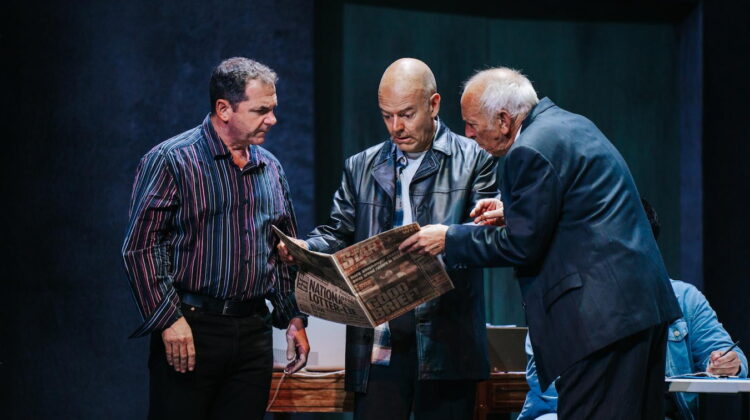
The Full Monty. Photo: Justin Mamo
The Full Monty play (not the musical) has made it to Malta thanks to MADC. This is the first time I was seeing the stage version, but the 1997 film remains one of my favourite ‘feel good with moments of feel sad’ tales – with the feel good part triumphing in the end. Does the Malta, MADC/Teatru Manoel production also triumph? Let’s find out.
The Full Monty – production details
| Play | The Full Monty |
| My rating | ⭐⭐🌟 (2.5/5) |
| Writer | Simon Beaufoy |
| Producer | MADC/Teatru Manoel |
| Director | Francesca Briffa |
| Main cast | Alan Paris, Stephen Oliver, Brendon Thearle, Lewis Preston, Shaun Rizzo, Taha Chaudhry, Pia Zammit, Coryse Borg, Steve Casaletto, Angelica Sant, Sarah Jane Zrinzo, Antonio Tufigno, Keira Galea, Richard Godden, Alan Azzopardi and Matthew Grech Marguerat, Simon Tufigno & Charlie Paris |
| Set designer | Romualdo Moretti |
| Dates | October 24, 25, 26, 31, November 1, 2 |
| Content warnings | Mature themes, nudity |
| Venue | Teatru Manoel |
| Duration | 2 hours 20 minutes, including short interval |
| Language | English |
The Full Monty narrative
The original movie landed its author Simon Beaufoy a BAFTA for the best film in 1997 and the Best Touring Production Award for the play in 2013. And if The Full Monty were to be having its first public airing today, I’m pretty sure it would receive even more accolades given that the themes are very current and extremely relatable.
On the surface this is a straightforward story about six unemployed blokes from Sheffield who – inspired by the Chippendales’ tour – decide to make a quick buck by moonlighting as strippers. So far, so light-hearted, you may say. Beaufoy’s genius lies in the way the script makes a strong statement about male vulnerability, mental health, homosexuality and the pressures of society for men to be ‘macho’ – all while maintaining levity.
He also avoids making the secondary female characters one-dimensional, or unrealistic comic foils. Some authors may have taken the easy option of depicting the characters of Jean (Dave’s wife) and Mandy (Gaz’s ex-wife) as the obvious villains. But not Beaufoy, who creates sensitive, sensible, layered characters despite their very short stage time.
It is Beaufoy’s human approach that ultimately makes The Full Monty such an awesome story. Not even a scene of attempted suicide manages to darken the tone. And yet, its effects sink in, encouraging the audience to discuss and to think about the implications of what we’ve just seen without ruining the feel-good factor. I was very pleased that MADC opted for the play version, rather than the musical, given the latter kind of ruins everything by transporting events from Sheffield to the US.
The Full Monty – direction and staging
I usually focus on the cast first, but in this case the directorial and staging choices impacted the performances considerably. Direction is by Francesca Briffa, who beautifully balances the humour and sensitivity required from the script. The scene where Dave and Gaz foil Lomper’s suicide attempt is one of the toughest balancing acts. Briffa’s direction shines a compassionate light on the pressures attached to male sexuality, while keeping us firmly in comedy territory.
Unfortunately, Briffa’s direction and Romualdo Moretti’s staging end up locked in a tug-of-war between momentum and mechanics, each set change grinding the story to a halt with exaggerated downtime. The over-literal stage design, coupled with protracted costume changes, completely broke the illusion and had large segments of the audience chattering for minutes on end while waiting for the action to resume.
Other productions that likewise include multiple locations have taken a more practical approach to the potential problem of fast set changes. Adrian Mamo’s set for A View From The Bridge kept a uniform staging, using lighting and small modular changes to suggest shifts from the Carbone apartment to the street outside and Alfieri’s office.
Kif Tgħallimt Insuq, which was staged last spring, is another case in point, albeit performed in a much smaller space and requiring a more abstract theatrical approach. And yet, a chair becomes a car seat or a kitchen scene, removing any need for downtime. Chucky’s Solo Panto is a third, with multiple costume changes and set transitions and almost zero downtime.
It’s worth making two observations that are not purely limited to The Full Monty. The first highlights the urgent need for appropriate (and affordable) rehearsal space. This may have mitigated the pacing problems faced by The Full Monty team, to a certain extent. The cast only moves into Teatru Manoel during production week, and with shows of this scale you do need alternative spaces that allow you to rehearse the job properly. Interestingly, School of Rock, which ran a few weeks earlier, did not encounter these issues despite having complex staging.
The second relates specifically to MADC – or, Malta Amateur Dramatics Club – productions. The Teatru Manoel website makes use of the adjective ‘amateur’ in its event blurb, which suggests that audiences and critics should adjust their expectations. I find this disingenuous.
Ticket prices and venue do not align with this label, and neither does the scale and professional approach of most MADC productions, such as this year’s competent staging of Shakespeare in the Garden (King Lear).
Last year’s The Beauty Queen of Leenane is another example – superbly produced, directed and acted, with no reference to ‘amateur’ in place (and rightly so).
The Full Monty cast
The cast’s performance was unfortunately over-shadowed by the two above points, which impacted the pacing to such an extent that it was almost like the story was starting from scratch everytime. Northern accents were inconsistent, apart from Alan Paris’s Gaz, who maintained a uniform performance. The rest of the cast had problems making themselves understood at times, and completely lost their accents at others.
The six leads (Alan Paris, Stephen Oliver, Brendon Thearle, Lewis Preston, Shaun Rizzo, Taha Chaudhry) did rise to the considerable physical demands made by the script with chutzpah. The dance sequences elicited the expected hilarity without making any of the actors look like fools.
The gran finale that earns the play its title was as spectacular as we could have wished for. Briffa opted for the template created by the original 2013 premiere at the Sheffield Lyceum. The full monty is indeed achieved, while modesty is preserved with a blast of bright backlighting. Effective, hilarious and totally unsexy – which is exactly the desired effect, but not one that’s easy to achieve. The combined experience of the troupe and the spot-on lighting made it possible, and the whole theatre erupted in applause and wolf-whistles.
The Full Monty – verdict
The production ends on such a high note, the feel-good factor entirely achieved, that it is highly tempting to forget all the other flaws. But that would be a misrepresentation. Ultimately, this production is let down when it comes to the most important technical requirements placed on it by the script.
The Full Monty is known for being a tough cookie in terms of set and costume changes. I had enough time to indulge in entire conversations during the downtime. The two-minute, feel good gran finale, sadly, cannot justify the preceeding two hours and 20 minutes.
Affiliate/Advertising Disclaimer: How I Carry Out Reviews
I received no payment for this The Full Monty review and I was offered press tickets. The opinions expressed here are purely my own and the producers had no input/control over what I wrote. There are no affiliate links contained within this page. To learn more about my policies and my reviewing process, visit my Affiliate/Advertising disclosure page. To better understand what my rating means, check out the details of the star system.