

Last Updated on September 22, 2026 by Ramona Depares
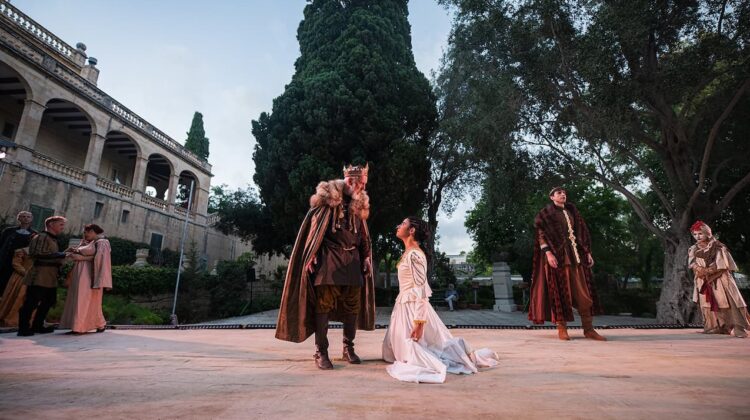
MADC’s King Lear at San Anton gardens. Photo: Facebook
This summer MADC have opted for a pinnacle of classical tragedy for their annual Shakespearean offering – King Lear. Hardly the easiest of plays to market, in the current climate of short attention spans and instant gratification.
And yet, as per tradition, the droves made their way to San Anton gardens for two and a half hours that married grandeur, wit and visceral anguish. Here are the essentials.
Table of Contents
MADC’s King Lear production details
| Play | King Lear |
| My rating | ⭐⭐⭐🌟 (3.5/5) |
| Writer | William Shakespeare |
| Director | Chris Gatt |
| Executive producer | Stefan Karl Magri |
| Stage Manager | Marco Mallia |
| Cast | Stephen Oliver, Faye Paris, Daniela Carabott Pawley, Melissa Mercieca, Bernard Zammit, Edward Caruana Galizia, Michael Mangion, Simone Ellul, Daniel Formosa, Alex Weenink, Leah Grech, Taha Chaudhry, Shaun Rizzo, Neil Cutajar, Tyrone Grima, Sam Casha, Keira Galea, Stephen Galea & Tamzin Lewis |
| Assistant stage manager | Justine Kyle Camilleri |
| Dates | Run ended |
| Content warnings | Some violence |
| Venue | San Anton Gardens |
| Duration | 2.15 hours |
| Language | English |
King Lear narrative
King Lear brings us Shakespeare at his most unforgiving. We’ve got an ageing king who decides to divide his kingdom among his three daughters – Goneril, Regan, and Cordelia – based on how lavishly they profess their love for him. When his youngest daughter, Cordelia, refuses to flatter him, he banishes her.
Cue chaos, betrayals, and wanton cruelties that eventually lead to most of the main characters kicking the bucket. There’s no need to throw in a ‘spoiler alert’ here. With a Shakespearean tragedy, the ending is never a mystery. It’s the kind of tale, written in the kind of language, that doesn’t allow the audience to sit on the fence. You will either relish the high drama of it all, or pull a Daisy May Cooper and scoff, in which case you’re unlikely to be the target audience for this review.
The themes do resonate strongly – and scarily – with current global events, as we appear to be surrounded by a plethora of danerous egos in power. I can think of at least three King Lears who could give Shakespeare’s protagonist a good run for his money.
Direction and staging
Director Chris Gatt brings us a King Lear that stays true to tradition. There’s no modernising, Yaël Farber-style, no attempt to give the classic tale a more contemporary flavour through politics, dress or staging. What we get is a production that resists reinterpretation, presenting King Lear in its classical form, the staging honouring the play’s original tone and period.
This left me feeling ambivalent. The approach works perfectly fine, and I certainly am not advocating a Merry Wives of Windsor (Terrace) approach. That said, I couldn’t help feeling that it would have been good to see Gatt taking more of a creative risk with such a great work. Granted, the themes are very different, but he had done this very effectively with Dario Fo’s No Pay? No Way! at Theatre Next Door, inserting various nods to local politics.
Staging and costumes followed this purist lead. MADC’s Shakespeare productions are well-known for allowing the unique setting of San Anton gardens to speak for itself, and this year was no different. Gatt certainly made full use of the grounds, allowing the wider surroundings of the natural landscape to be pulled into the drama, blurring the lines between the set and the real world.
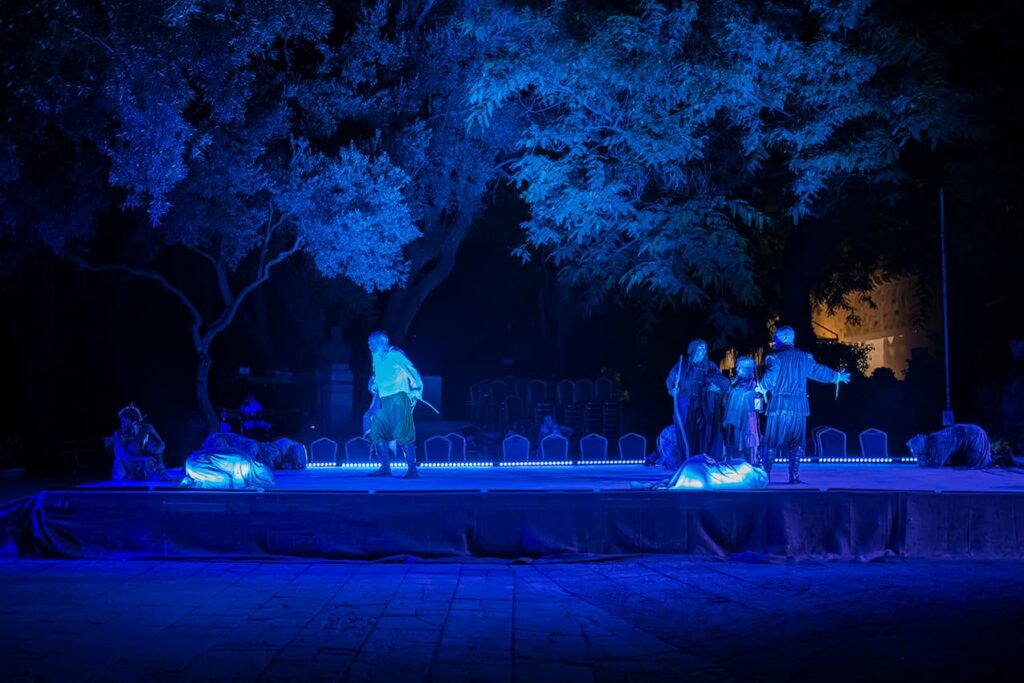
Light and sound, however, struggled to capture the intensity of what was unfolding on stage, particularly during the storm sequences. The same cannot be said of Nichole Cuschieri’s costume design and wardrobe touches. The headwear, in particular, was stunning, creating a sculptural interplay of twigs, leaves, and natural elements that echoed the wildness of the setting. I had already seen Cuschieri use this technique for one of What’s Their Names Theatre Shakespeare productions and she has now refined her craft considerably. Her minimalist costume trappings for Poor Tom deserve special attention (as does the make-up artist).
The cast
Stephen Oliver is majestic in the title role. We are first introduced to him as the playful patriarch, frolicking with the Fool (played by a very young and promising Leah Grech). But almost immediately, this benign vision is shattered, as the infamous scene with the three daughters unfolds, revealing Oliver to be a ruthless, arrogant monarch.
As the narrative unfolds, Oliver captures the character’s psychological unravelling with mastery. And when the end comes, he is unrecognisable, no longer King or father but a man consumed by grief, betrayal and a complete collapse of identity.
The rest of the cast contribute varying degrees of skill to the production. Edward Caruana Galizia (Duke of Cornwall) and Daniela Carabott Pawley (Regan) are two deliciously credible psycopaths, the on-stage chemistry on point. Props to Carabott Pawley’s ever-present wine glass prop (sorry), a constant reminder of the character’s excesses. Carabott Pawley is excellent at characterisation, with the more recent Ħobżna ta’ Kuljum showing her in a very different role to equally polished effect.
Daniel Formosa, as the illegitimate son Edmund, does an excellent job delivering his asides to the audience with deadpan wit. He adds some well-needed black humour to the goings-on, and rises to the range required of his role – charming lover one minute, nasty snake the next. He is especially funny in his dealings with Goneril and Regan.
Alex Weenik delivers an admirable performance as Edgar, but it is his transformation into Poor Tom that really makes him shine. He brings a physicality to the character that leaves a marked impact on the audience. Simone Ellul brings poignancy and dignity to her Duchess of Kent, commanding the audience’s attention in these short scenes. And Michael Mangion’s Duke of Gloucester brings a heartbreaking loyalty and naiveté to his character. Not to mention that the director had quite a bit of fun with him in ‘that’ torture scene – as did we.
The rest of the cast acquitted themselves capably, albeit without any lasting dramatic imprint. Projection was an issue in more than one instance, especially when actors happened to facing the opposite side of the stage.
MADC’s King Lear – verdict
MADC’s King Lear presented a solid, if conventional, staging. Competent, and perfectly enjoyable, but never surprising. Stephen Oliver’s unyielding – and eventually undone – King Lear does a lot of the heavy lifting, his absence on stage felt instantly. But I was left yearning for the boldness that the director had injected into his 2007 A Midsummer Night’s Dream, also for the MADC.
Affiliate/Advertising Disclaimer: How I Carry Out Reviews
I received no payment for this King Lear review and I was offered press tickets. The opinions expressed here are purely my own and the producers had no input/control over what I wrote. There are no affiliate links contained within this page.To learn more about my policies and my reviewing process, visit my Affiliate/Advertising disclosure page. To better understand what the my rating means, check out the details of the star system.
Former Head of News at Times of Malta, turned freelance journalist and creative writer. Three books published, 3 journalism awards, 1 Arts Council Malta award, work published locally & internationally.