
Naħliflek. Photo: Elisa von Brockdorff
Naħliflek brings together three powerhouse actors for a story that’s both dismayingly relevant and inspirational, in one of the most powerful Maltese theatre productions I’ve seen recently. It is still running this weekend, and you’re not going to want to miss it for various reasons that I’ll soon be delving into with this review. But first, some details.
Naħliflek – production details
| Play | Naħliflek |
| My rating | ⭐⭐⭐⭐🌟 (4.5/5) |
| Writer | Breach Theatre |
| Translator | Kim Dalli |
| Producer | Daniel Azzopardi |
| Director | Marta Vella |
| Main cast | Kim Dalli, Clare Agius, Sarah-Lee Zammit, Claire Tonna, Analise Mifsud |
| Set designer | Romualdo Moretti |
| Light designer | Moritz Zavan Stoeckle |
| Sound designer | Mirko Galea |
| Costume designer | Nicole Cuschieri |
| Makeup | Krista Paris |
| Dates | October 17, 18, 19, 23, 24, 25, 26 |
| Content warnings | Rape, violence, language |
| Venue | Our Lady of Pilar Church, Valletta |
| Duration | 1 hour |
| Language | Maltese |
The narrative
Naħliflek is a translation of Breach Theatre’s It’s True, It’s True, It’s True, which premiered at the Edinburgh Fringe Festival in 2018. Translated to Maltese by Kim Dalli, it is essentially a rape courtroom drama, with 17th century painter Artemisia Gentileschi at the centre of the story. Gentileschi – who is now recognised for a talent on par with that of Caravaggio – was raped by artist Agostino Tassi , a friend of her father. She was 15.
The very public trial that ensued, complete with thumbscrews, was a manifesto for rampant misogyny, and yet Gentileschi did not bow down. Her talent was never recognised during her lifetime.
Dalli’s translation doesn’t limit itself to the script. She goes straight to the period court transcripts on which the original play is based, weaving an added layer of authenticity that elevates Naħliflek to a more detailed and intimate encounter with Gentileschi. It is an approach that emerging playwright Chantelle Micallef Grimaud also follows to excellent effect in her script for Ġimgħa l-Ħabs.
It bears repeating that 2025 has seen a particularly rich crop of theatre translations, including Simone Spiteri’s exceptional Kif Tgħallimt Insuq – also centering around sexual abuse of a minor.
Likewise, it’s been a good theatre year in terms of throwing a spotlight on gender and sexual violence, with Masquerade and Teatru Manoel staging Arthur Miller’s A View from the Bridge a couple of weeks ago. It is edifying to see these difficult themes gaining more prominence at our theatres, without being limited to ‘special occasions’ such as Women’s Day.
In this case, Dalli rises to her reputation as a writer who focuses on gender rights from a historical perspective. Some of you may remember her segment on Her Say Not Hearsay, where she shone a light on the lives of women during war time. For another book-to-stage adaptation that shines the spotlight on a female protagonist who challenges norms, check out Marta Vella’s adaptation of Il-Ħajja Sigrieta tan-Nanna Ġenoveffa.
Naħliflek – the cast
The three main parts are filled by Dalli herself, Clare Agius and Sarah-Lee Zammit. Dalli takes on the bulk of the role of Gentileschi, with the other two actors occasionally rotating.
Agius, Dalli and Zammit take turns at portraying judge, painter, perpetrator and various witnesses. The nuances of each are different, but they all bring a larger-than-life element to each role. Zammit’s judge and perpetrator deliver an easy braggadocio that emphasises their privilege in society. Agius’s exaggerated drawls achieve the same effect, albeit via a different route. It’s interesting to contrast the different, yet equally effective, approach of each actor.
Dalli excels as Gentileschi, with the character’s progression from demure victim to fierce survivor leaving the audience raw. I could see some visibly emotional faces, and I will add that this is one case where the trigger warnings ought to be heeded. Dalli’s portrayal is not for the faint of heart and she puts everything she has into the role.
Direction, staging, sound
The piece has director Marta Vella’s distinct signature. Vella introduces a contemporary element, alongside a dash of dark humour. The approach is not too different from that taken in Blanket Ban (which she co-wrote), although it is a lot more effective here.
A particular segment presents the contrast between the feminist approach Gentileschi takes in her depiction of Susanna & The Elders, and that taken by Annibale Carracci – which depicts Susanna as more sexually available. Vella opts for a contemporary approach, and Dalli’s interpretation creates a chilling – albeit humorous – depiction of the male gaze. Vella’s direction is sharp; the audience laughs even while deep down we are all shocked. There was only one segment where I felt this mix of the contemporary and the historical didn’t work, and this was the dance music scene.
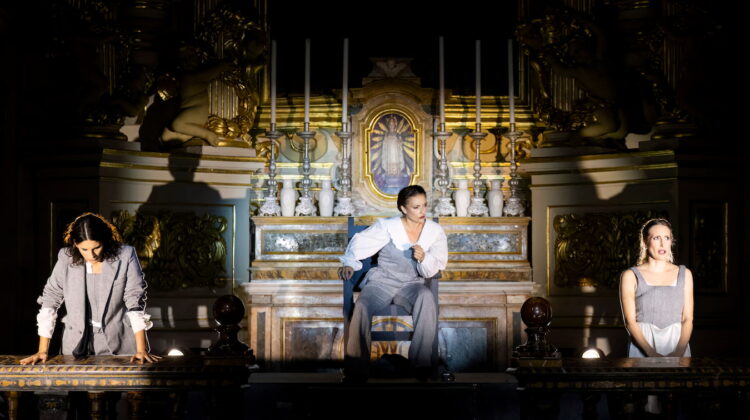
The venue, the Chapel of Our Lady of Pilar in Valletta, is inspired and needed minimal set construction. The altar space naturally brings to mind the structure of a court room, and the baroque masterpieces make it very easy to suspend our disbelief and to place ourselves in the environment of an old Florentine Palazzo. Romualdo Moretti’s choice to include a catwalk style section worked, bringing the actors closer to the audience in what is already a very intimate space.
Lighting by Moritz Zavan Stoeckle is pretty much perfect – bold and shifting with the mood on stage. Chanting is used to great effect, the beauty of the vocals (under the direction of sound designer Mirko Galea) providing a sheer contrast to the drama unfolding on stage.
I then discovered that the chants were being performed live by Claire Tonna, whose solo adds a spectacular conclusion to the play. The use of the mic here is unnecessary as Tonna’s voice is incredibly powerful. Acoustics in the chapel are particularly difficult, and each time the mic is used it is impossible to make out what was being said/sung, detracting from the impact.
Naħliflek – the verdict
Director, cast and crew are equally formidable. This is an intense piece, with the type of dramatic intensity that requires high-level skill to handle. I will say this – it may be triggering to those who are particularly sensitive to themes of rape and sexual violence. There is nothing subtle about this play, and nor should there be. But audiences should be forewarned.
If you feel like you’re up to a challenging, exceptionally executed theme that will make you reflect and debate, keep your fingers crossed that there may still be some tickets left for this weekend’s performances.
Naħliflek is supported by Arts Council Malta, in collaboration with the Istituto Italiano di Cultura, La Valletta & Heritage Malta.
Affiliate/Advertising Disclaimer: How I Carry Out Reviews
I received no payment for this Naħliflek review and I was offered press tickets. The opinions expressed here are purely my own and the producers had no input/control over what I wrote. There are no affiliate links contained within this page. To learn more about my policies and my reviewing process, visit my Affiliate/Advertising disclosure page. To better understand what my rating means, check out the details of the star system.