

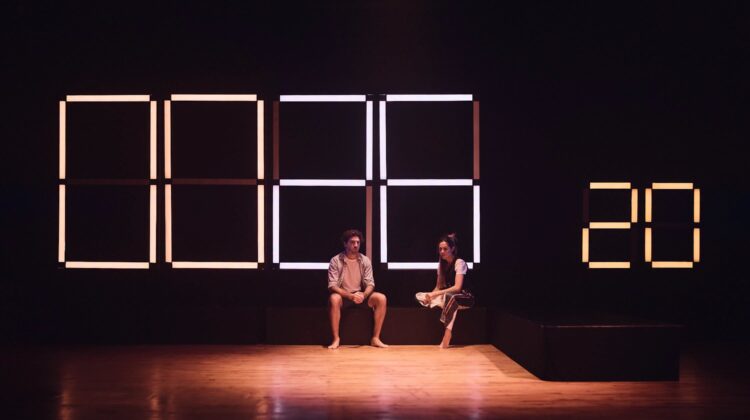
Ilma is a new script by Simone Spiteri, her second play to premiere this year after the superb Ħobżna ta’ Kuljum and, on the surface, somewhat of a departure from the themes I’ve come to associate with this theatre-maker. The story revolves around Ethan, a former elite swimmer who is forced to confront buried childhood trauma. Strong performances, direction and staging all contribute to an outstanding production that, nonetheless, presented some missed opportunities for deeper characterisation.
Ilma – details
| Play | Ilma |
| My Rating | ⭐⭐⭐⭐🌟 (4.5/5) |
| Producer | Denise Perini, Studio 18 Malta |
| Script | Simone Spiteri |
| Cast | Gianni Selvaggi, Sander Agius, Antonella Galea Loffreda, Nadine Farrugia |
| Set design | Andrew Borg Wirth |
| Light design | Niels Plotard, Toni Gialanze |
| Music composition | Aleandro Spiteri Monsigneur, Chris Gatt |
| Movement director | Rochelle Gatt |
| Costume designer | Michela Manduca |
| Production manager | Lisa Baldacchino |
| Deputy stage manager | Carla Abela |
| Sound engineer | Shaun Vella |
| Running Time | 1 hour 30 minutes, no interval |
| Content warnings | Reference to sexual harassment, trauma |
| Dates | November 6 – 15 |
| Venue | Valletta Campus Theatre |
| Language | English |
Ilma – the narrative
Simone Spiteri’s new script, Ilma, is a no-holds-barred indictment of the overly competitive world we live in, the plot device being the elite world of teenage swimmers competing for the nationals. The protagonist is Ethan, an adult who has long left that world behind him. We learn that the sport traumatised him so badly as a teenager that he now refuses to so much as dip his toe in the water.
When he bumps into Cara, a former team mate he had a crush on when he was 16, he has no choice but to confront the events that happened on the day of his last race. Cara reveals that she was sexually harassed by another teenage swimmer who was also Ethan’s biggest competitor. She asks Ethan why he didn’t acknowledge what had happened, or even get in touch with her after she disappeared from the sport. But Ethan can’t remember anything that happened on one of the most important days of his life.
As the play unfolds and he becomes more obsessed with finding the missing pieces, Ethan’s mental state starts unravelling. Spiteri’s narrative alternates between the present timeline and the days leading to the race as we see the teenager undergoing a constant stream of bullying from his mother and his coach, forced to endure a gruelling physical regime.
In the present day we witness Ethan’s deteriorating relationship with his pregnant partner, as well as his encounters with the adult Cara, conversations with his colleague, and the sessions with his therapist. At the heart of it all is the Fibonacci sequence, which Ethan uses as his mantra, constantly reciting the numbers as a means to cope with his anxiety.
In what is perhaps a reflection of the mathematical sequence itself, Ilma opens with a series of very short, staccato scenes that gradually grow longer. The rapid dialogue and scene transitions succeed in creating a high-stakes, emotionally charged story arc that maintains its sense of urgency. The audience is kept constantly on tenterhooks as we await a resolution to this emotional reckoning.
That said, it would have been interesting to see a deeper exploration of Ethan’s own unresolved trauma, particularly why a chance encounter and a revelation from a former teammate triggers an emotional crisis deep enough to make him temporarily abandon his pregnant partner. We are told that Ethan had already been seeing a therapist at his partner’s insistence. Yet, we are never given a clear indication of what aspects of his behaviour or psychological state had prompted this concern in the first place. The suggestion that Ethan loses the crucial race because Cara is cheering for his rival also feels like an apparent contradiction to the script’s repeated insistence that he ignores anything that’s unrelated to the race.
Ilma – the cast
Gianni Selvaggi is outstanding as Ethan, and we ache for the vulnerable teenager, prey to the ambitions of his coach and the failed dreams of his mother. He switches from teenager to adulthood with a natural ease that would almost have us believe we’re watching two different actors. It’s a demanding role, and not just because of the shifting timelines and rapid scene switches. A significant part of the action takes place in, under, and around water, and getting the audience to suspend its disbelief requires a strong level of creative physicality. Selvaggi makes it look effortless.
He is very ably supported by a small, but wonderful cast who all take on dual roles. Sander Agius as the Coach embodies all the elements of an adult bully. Perhaps we’re more used to seeing this actor in comic roles, his excellent turn as the love interest(s) in Il Ħajja Sigrieta tan-Nanna Ġenoveffa a case in point. As Coach, he masterfully delivers a very different flavour (though he also makes us chuckle when doubling as Mark). I would have loved to see the Coach’s character given more depth — as it is, even in the short stage-time afforded him, Agius’ performance has us invested.
Antonella Galea Loffreda makes for a terrifyingly credible mother who’s trying to vicariously grasp at success through her son. It is here that Spiteri’s script is at its most effective, as Galea Loffreda chillingly brings to life a character that too many young students, athletes, musicians will recognise. She abruptly switches cadence from doting mother, singing “happy birthday, sweet 16”, to a manipulative abuser who screams at her son after he expresses a wish to attend a friend’s birthday party. Nadine Farrugia brings a sensitivity and wisdom to the role of Cara that make her backstory all the more poignant.
Direction, staging and lights
I’ll cut right to the chase: direction, staging and lights are a triumph. Hats off to director Jean-Marc Cafá for taking a script that many would have thought could only work with complex staging and props, and showing us how it should be done — with minimal staging, ingenious lighting and sound cues and precise direction that allows zero room for errors. Of which, there were none.
Cafá keeps tight control over pacing, reining in each performer without stifling their individuality or diminishing the emotional intensity of their performances. The director excels at this, as we have already seen in productions like A View from the Bridge.
Andrew Borg Wirth’s minimalist set saw an oversized digital clock dominating the back of the stage, its illuminated segments cleverly doubling as swinging doors through which the actors made their entrances and exits. Even when visible behind the structure, the performers adhered to precise blocking, creating a unique interplay between movement and set design.
Niels Plotard and Toni Gialanze (light design) and Shaun Vella (sound engineer) all carry out their respective roles superbly. This is the sort of show where each cog needs to fit in seamlessly for a co-ordinated whole. And that’s exactly what they all did, every cue perfectly met by its counterpart. Aleandro Spiteri Monsigneur and Chris Gatt (musical composition and soundscapes) provide the final accomplishment of this polished puzzle.
Ilma – my verdict
Ilma is another excellent script from Simone Spiteri. It is masterfully brought to the stage by director Jean-Marc Cafá alongside a very skilled cast and crew. Minor quibbles about characterisation aside, this made for an intense theatre experience that cast an effective spotlight on the ills of our hyper-competitive society, viewed through the lens of an elite athlete. It does so in a very human way that, while disturbing and giving plenty of food for thought, also offers compelling story-telling. Undoubtedly deserves another run.
Former Head of News at Times of Malta, turned freelance journalist and creative writer. Three books published, 3 journalism awards, 1 Arts Council Malta award, work published locally & internationally.