

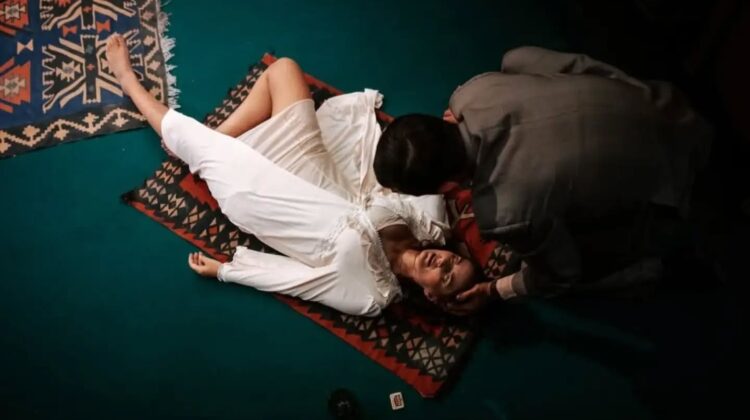
Il-Baħar Ikħal Skur is Immanuel Mifsud’s translation of Terence Rattigan’s The Deep Blue Sea. I had seen the National Theatre’s version, starring the late (and supremely talented) Helen McCrory, also of Peaky Blinders fame. The chamber play showed in Malta at Spazju Kreattiv and was directed by Tyrone Grima, who delivers a poignant production punctuated by subtle humour, albeit falling short of the dramatic tension required to sustain it. Here are all the production details.
Il-Baħar Ikħal Skur – details
| Play | Il-Baħar Ikħal Skur |
| My Rating | ⭐⭐⭐⭐ (4/5) |
| Producer | Sharon Bezzina, Tyrone Grima |
| Playwright | Terence Rattigan |
| Translation | Immanuel Mifsud |
| Cast | Sharon Bezzina, André Mangion, Joseph Paul Vella, Carlos Farrugia, Lilian Pace Vassallo, Juan Grima, Robyn Vella, Joseph Fenech |
| Set design | Romualdo Moretti |
| Light design | Dali Aguerbi |
| Sound design | Ann-Marie Camilleri |
| ASM | Graziella Galea Pirotta |
| Running Time | 1 hour 15 minutes, plus interval |
| Content warnings | Suicide |
| Dates | October 30 and 31, November 1, 6, 7, 8 |
| Venue | Spazju Kreattiv |
| Language | Maltese |
Il-Baħar Ikħal Skur – narrative & translation
Il-Baħar Ikħal Skur is a slow burn of a script. It takes place in the living room of the protagonist Hester Collyer, a young woman who leaves the staid boredom of life with her husband Judge Collyer for the excitement and passion provided by Freddie, an ex-RAF pilot. Freddie is the ultimate commitment phobe, and Hester discovers that she can’t deal with this. The play opens in the aftermath of her failed suicide attempt after Freddie forgets her birthday.
We’re immediately introduced to the neighbours who come to the rescue, including ‘Dr’ Miller, who was struck off the register for reasons not spelt out. The original script was written in 1952 and was based on the author’s secret relationship with the actor Kenny Morgan, who died by suicide. This was a time when both homosexuality and suicide were criminalised, which made it impossible for Terence Rattigan to be more direct in the creation of his protagonist.
Rattigan’s script is multi-layered, and he takes his time revealing the emotional complexities at the heart of the narrative, an approach that would have worked well in the 50s. The Maltese production of Il-Baħar Ikħal Skur sees the timeline brought forward to the 60s in an accomplished translation by Immanuel Mifsud.
Il-Baħar Ikħal Skur – cast
Sharon Bezzina takes on the lead role as Hester. She throws herself wholeheartedly into the emotionally demanding role, delivering a committed and respectable interpretation. Bezzina’s emotional investment pays off, delivering a Hester that is increasingly vulnerable. Rattigan’s script hints at Hester’s conflicting feelings between the real love she has for her husband and the attraction for Freddie. Bezzina’s nuanced performance does justice to this complex characterisation, the only niggle being the lack of dramatic intensity during the more climactic moments.
It took me a hot minute to get attuned to André Mangion’s accent in the role of the foreign Dr Miller. I’m not sure accents are the best way to denote foreignness in today’s world, a point that also cropped up for me in Amelie – The Musical. However, Andre Mangion’s portrayal is excellent. He gives us a quietly sardonic interpretation, imbued with poignancy, compassion and deadpan humour that gives the original character the depth Rattigan intended.
Carlos Farrugia is Freddie, the flighty love interest and another complex character. Farrugia does justice to the role: he pivots from happy-go-lucky boyfriend with an easy swagger to the callous and emotionally stunted persona that he is. The actor allows us to glimpse fleeting moments of vulnerability before the final moment of honesty at his departure. Farrugia’s performance is key to understanding Hester’s obsession, and he conveys all these qualities successfully.
Bezzina, Farrugia and Mangion are complemented by a competent cast that takes on the secondary roles with skill.
Il-Baħar Ikħal Skur – direction and staging
Director Tyrone Grima opts for the intimate Spazju Kreattiv theatre space, using short pre-show sequences to introduce us to Hester’s domestic life. His direction is restrained enough to allow Rattigan’s characters and their complicated relationships to take centre stage. Hester’s loneliness is cleverly conveyed through the presence of an ongoing solitaire card game.
That said, a bolder interpretation may have succeeded in bringing the play’s underlying themes of sexual repression and social ostracism into sharper focus. As it is, the undertones related to Dr Miller’s sexuality barely register in today’s age. Also somewhat ironically, the production may have benefited from more time allowing Sharon Bezzina’s Hester to build the momentum required for the dramatic tensions and contrasts that are crucial to the pacing.
Much in the same vein as my review of Oscar Wilde’s Salomé, a successful staging of a classic goes further than simply recreating the original text. It also means considering how audiences have changed, and whether the production gives the dramatic and social nuances of the work the required weight.
Romualdo Moretti’s set immediately establishes the timeline with period furnishings and a configuration that brings us in very close proximity to to Hester’s private world. The space feels intimate rather than oppressive. Even with the neighbours constantly dropping in, the set never quite conveys the sense of social scrutiny that permeates Rattigan’s text, the neighbours’ presence coming across as caring and not as an intrusion upon her privacy.
Il-Baħar Ikħal Skur – my verdict
Il-Baħar Ikħal Skur is a solid and engaging production that does justice to Rattigan’s work, even if the aforementioned shortcomings prevent it from being outstanding. The cast delivers committed performances, supported by a thoughtful direction that largely allows the emotional complexities of the narrative to speak for themselves.
Crucially, the production succeeds in making us care about Hester and her predicament. Her vulnerability, the contradictions in her relationships and her desperate search for happiness remain poignant throughout. This emotional connection is ultimately what makes Il-Baħar Ikħal Skur a rewarding theatrical experience. The dramatic tension occasionally falters, but there is plenty to appreciate in this sensitive exploration of loneliness and the painful consequences of human desire.
Former Head of News at Times of Malta, turned freelance journalist and creative writer. Three books published, 3 journalism awards, 1 Arts Council Malta award, work published locally & internationally.