

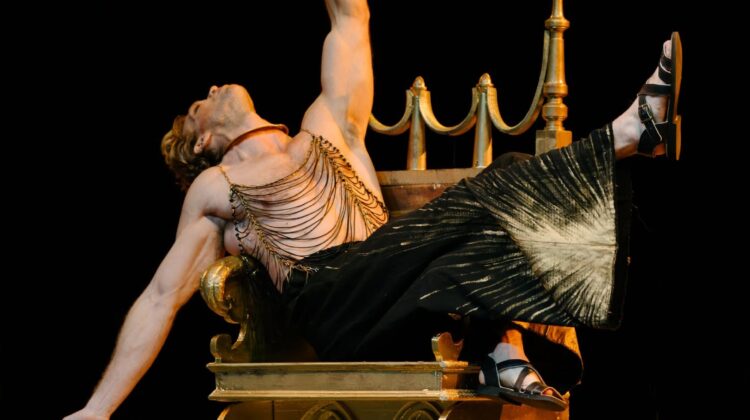
Oscar Wilde’s Salomé is rarely staged nowadays, for some very good reasons that I’ll get into soon. But, I’ve been looking forward to the Teatru Manoel production for months. I’m not gonna lie: knowing that Rivals star Timothy Blore was taking the title role made the anticipation juicier. That said, one big name isn’t enough to guarantee something that’s extraordinary.
Thankfully, my concerns about this staging, while not entirely unfounded, were not realised. Under Adrian Buckle’s direction, the tale of obsession and power takes on a new dimension, with a bold interpretation that gives Wilde’s original themes new resonance. Before I dive in further, here are all the details.
Salomé by Oscar Wilde – details
| Play | Salomé by Oscar Wilde |
| My Rating | ⭐⭐⭐⭐ (4/5) |
| Producer | Teatru Manoel |
| Playwright | Oscar Wilde |
| Adaptation & Direction | Adrian Buckle |
| Cast | Timothy Blore, Tarik Badwan, Mikhail Basmadjian, Magda van Kuilenberg, Joel Parnis, Victor de Bono, Miguel Muscat, Barry Kolman, Francesco Borg, Karl Schembri |
| Dancers | Sarah Vella, Mona Fazaa, Angela Bettoni and Rebecca Grech |
| Choreographer | Chakib Zidi |
| Music & Sound design | Albert Garzia |
| Set design | Romualdo Moretti |
| Light design | Chris Gatt |
| Costume design | Aleksandra Idowiak |
| Stage manager | Marco Mallia |
| ASM | Marvic Massa |
| Intimacy director | Simone Ellul |
| Make up | Talitha Dimech |
| Production manager | Jonathan Grima |
| Running Time | 1 hour 40 minutes, no interval |
| Content warnings | Nudity. Classified 16+ |
| Dates | November 6, 7, 8, 13, 14, 15 |
| Venue | Teatru Manoel |
| Language | English |
Salomé by Oscar Wilde – the narrative
Salomé is a one-act tragedy by Oscar Wilde that was first published in French in 1893. What does a 21st century audience care about a 19th-century script, you may ask?
Well, Wilde’s version is a considerable departure from the biblical original it stems from. The bible had Salomé dancing for King Herod and demanding the head of John the Baptist (aka the prophet Jokanaan) at her mother’s behest. Not out of sexual obsession but out of pure pettiness.
Wilde takes us down a different pathway that’s even darker than the one in the bible, if such a thing is possible. He gives Salomé an obsession for Jokanaan, who proceeds to tell her in no uncertain terms that she gives him the ick and it’s never going to happen. From there on, things go belly up for the prophet.
Crucially, Wilde’s Salomé is no mere tool. She uses her agency to demand the execution of Jokanaan, and she does so out of her own unrequited lust. To add a further twist, director Adrian Buckle’s interpretation casts Salomé as a prince who identifies and presents as a woman. You can consider the contemporary zeitgeist satisfied.
In short, thematically, this is all very relatable. Text-wise, well that’s a bit of a different kettle of fish. I’m a huge fan of Wilde’s witticisms and works. Some of his works, like Lady Windermere’s Fan and The Importance of Being Earnest are evergreen — both with respect to narrative and language. Salomé, not so much.
Here, Wilde departs from his usual style to favour heavily stylised prose. The text is repetitive, sometimes almost coming across as a chant or mantra. It may have worked perfectly at the time it was first published. Today, it presents a very real risk that it comes across as unintentionally comedic. I mean, kissing a decapitated head is never going to be visually traumatic to an audience used to 21st-century special effects. You see where I’m going with this.
Salomé by Oscar Wilde – direction & set design
I’ll invert the order of my reviews this time, starting out with direction, as the point I just raised above very much depends on directorial choices and talent. An unskilled hand would undoubtedly doom the production, no matter how skilled the cast.
In recent years, director Adrian Buckle has directed a series of perfectly competent productions that, however, were hardly game-changers. One of these was Id-Dnub tal-Magħżulin, which incidentally is also a take on a different biblical tale. But through these past months Buckle seems to be returning to the roots that had made his Unifaun Productions such an exciting force on the local theatre scene. This was also signalled by his staging of Genet’s The Maids a few weeks ago.
For Oscar Wilde’s Salomé, Buckle is clearly very aware of the pitfalls that come with the text. He manages to resolve them very effectively through the simple expedient of plunging us into an otherworldly landscape where gorgeously ornate costumes, a smoke machine, and Romualdo Moretti’s clever set design do wonders to help suspend our modern reactions to Wilde’s stylised script.
The stage is dominated by large columns, with the action largely taking place at the front of the stage. But there’s more to it than first meets the eye, as actors move tantalisingly in and out of the shadows, the columns acting as gateways to a multi-layered world. It’s a deft directorial move from Buckle, constantly keeping the audience on edge, wanting more.
This works particularly well during the Dance of the Seven Veils, when we first catch sight of Salomé wafting between the columns, appearing and disappearing from view before the action moves to the foreground. The effect lends a dreamlike quality to the staging, making what remains unseen just as intriguing as what unfolds before us. As audience, we allow ourselves to flow within this liminal state where even the most baroque elements of the play feel natural.
There is, however, one considerable fly in the ointment — pacing. The play kicks off with a lengthy dance sequence, and it takes quite a while for the narrative to kick in. The plot is paused again multiple times throughout the play, for other dance sequences and for the Page of Herodias to sing/chant after the death of the Young Syrian Captain.
While these sequences are individually well executed, their cumulative effect significantly disrupts the dramatic momentum. This is particularly frustrating in a production that otherwise generates such powerful tension. Wilde’s text is already sufficiently reiterative without adding embellishments that further slow down pacing. Perhaps, these additions would have worked better as complementary devices, instead of having them replace the main action.
Salomé by Oscar Wilde – the cast
I’ll get this out of the way: for those of you screaming ‘woke’ blue murder, director Adrian Buckle’s decision to cast a man in the title role is part of the play’s performance history. Wilde’s Salomé has long been associated with queer and camp aesthetics. Drag artist Lindsay Kemp is probably the most iconic example, going back to 1975; in 2017, the title role was given to Matthew Tennyson, with the play exploring the ambiguity of gender and sexuality.
Watching Timothy Blore take on this role was as much of a joy as I was hoping for. Blore brings such visceral intensity to the role that the question of Salomé’s gender is the least important part of the performance. He moves effortlessly between desire, vulnerability, manipulation and cruelty and, in this, I was reminded of Anton Saliba’s and Victor De Bono’s performances in the recent production of the afore-mentionedThe Maids.
The apex of Blore’s performance is, of course, the Dance of the Seven Veils. Again, the potential for cringe is very real. But no. Blore gives us a masterclass in psychological and sexual tension, which he maintains throughout the entire play to be fair. His mastery of movement is impeccable. Missing just one light or sound cue during the dance would have been a disaster.
Equally impressive is Blore’s capacity to transmit an entire world of disturbing emotions in one, icy stare. Listen, he repeated “Bring me Jokanaan’s head” as many times as Wilde’s script dictates without eliciting a single eye-roll from me. There’s more. He kept the two ladies in the box to my left off their phones for the entire dance, and through the sequences that followed. Now that there, readers, was no mean feat.
Tarik Badwan takes on the role of Jokanaan and, of course, his Royal Opera House and Netflix credentials also set high expectations. Expectations that he meets, bringing a commanding stage presence and an otherworldly intensity to the role, despite not having that much time in which to do so. There is something deeply foreboding about his portrayal, the sense of impending doom he creates also integral to our acceptance of this very demanding script.
The Maltese cast is just as formidable. Mikhail Basmadjian, fresh from a very different role in Yasmina Reza’s Arti, is magnificent in the role of Herod. The serious predator vibes are punctuated with quasi comedy as we watch him thirst after Salomé, and it works. I swear it felt just like watching your average horndog Neanderthal male sitting in your typical Maltese square. I never expected to write this sentence, but Basmadjian pulls off what Al Pacino reportedly didn’t when he took on the role of Herod in 2003.
Magda van Kuilenberg’s Herodias is beautifully nuanced – crafty and fiercely protective of her position, with an undercurrent of bitterness. van Kuilenberg has revealed herself to have a strong skill for playing complex, multi-layered characters, her most recent turn in Ħobżna ta’ Kuljum being a case in point.
Joel Parnis’ turn as Page of Herodias comes into its own during the song/chant numbers I referred to earlier. These may not have done the pacing any favours, but they were hauntingly executed by Parnis. The equipe of five dancers, under the direction of Chakib Zidi, is also skilful — I enjoyed the parts where they were complementing the main action, adding an unexpected layer to its psychology.
Music and lights
Both elements are crucial to the success of this production. Albert Garzia’s original music surprises, in the best way possible. He takes a completely different approach to Alexander Glazunov’s incidental music for the original 1908 St Petersburg production that ended up getting banned.
Garzia blends classical and electronic music to haunting effect and, for the Dance of the Seven Veils, he presents us with a combination of music and jarring, percussive sounds. Aided by Chris Gatt’s faultless lighting design, the sequence becomes a charged piece of foreplay where seduction and aggression go hand in hand. The mounting tension keeps Herod — and us — quite literally on the edge of our seats. Glorious costumes and makeup complete this solid production of Oscar Wilde’s Salomé.
Salomé by Oscar Wilde – my verdict
In an age when we’re very aware that trauma breeds further abuse — and where narcissism appears to have become a more common personality type than most psychologists are ready to admit — Adrian Buckle’s production of Salomé stings. It stings because it makes us pose uncomfortable questions related to the way we decide who’s the ‘victim’ and, indeed, how victims become thus.
It’s difficult to ignore the fact that Oscar Wilde’s prose isn’t for everyone, or that the pacing falls short in quite a number of sequences. These interruptions prevent an otherwise exceptional production from sustaining its dramatic momentum throughout. Nevertheless, this is an aesthetically stunning staging, accompanied by superb performances from a cast that genuinely lives up to the star power that’s promised. An incredibly striking soundscape brings it all together. My advice to anyone who enjoys an evening at the theatre is not to miss it.
Affiliate/Advertising Disclaimer: How I Carry Out Reviews
I received no payment for this review of Salomé by Oscar Wilde, and I was offered press tickets. The opinions expressed here are purely my own and the producers had no input/control over what I wrote. There are no affiliate links contained within this page. To learn more about my policies and my reviewing process, visit my Affiliate/Advertising disclosure page. To better understand what my rating means, check out the details of the star system. Check out another formidable production, the Rocky Horror Show.
Former Head of News at Times of Malta, turned freelance journalist and creative writer. Three books published, 3 journalism awards, 1 Arts Council Malta award, work published locally & internationally.