
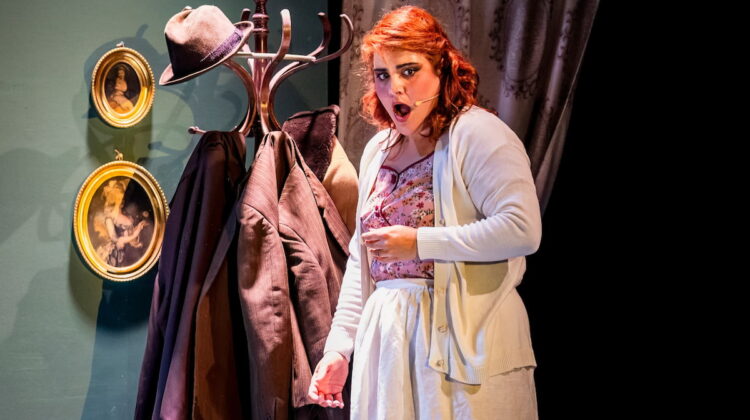
Il-Ħajja Sigrieta tan-Nanna Ġenoveffa. Photo: Udjenza / Facebook
It’s very rare that a theatre production comes along and I find nothing to nitpick. Well, here we are with Il-Ħajja Sigrieta tan-Nanna Ġenoveffa. The play is based on the original work by Trevor Zahra. Marta Vella’s adaptation keeps all the funnies and the feels, with excellent stage pacing.
The play is superbly – and inventively – directed by Toni Attard. Add an almost flawless cast that lives and breathes comic timing, and we’ve got our 5-star production right here. Before I delve deeper, here are all the details you need.
Table of Contents
| Play | Il-Ħajja Sigrieta tan-Nanna Ġenoveffa |
| My Rating | ⭐⭐⭐⭐ ⭐ (5 out of 5) |
| Producer | Udjenza |
| Director | Toni Attard |
| Author | Trevor Zahra |
| Adapted by | Marta Vella |
| Cast | Marta Vella, Josette Ciappara, Christine Francalanza, Sander Agius, Sean Borg |
| Set Design | Carlo Tonna De Lorenzo |
| Lights | Andre Micallef |
| Music | Matteo Depares |
| Costumes | Nicole Cuschieri |
| Sound Design | Costa Consulta Ltd |
| Production Manager | Denise Perini |
| Stage Manager | Annalisa Schembri |
| Venue | Teatru Salesjan |
| Dates | April 24 – May 3 |
| Duration | 2 hours plus 20-minute interval |
| Content warnings | Sex |
Il-Ħajja Sigrieta tan-Nanna Ġenoveffa: the plot
When Trevor Żahra’s book was first released by Merlin Publishers, it broke boundaries. It’s safe to say that no-one expected the beloved author behind childhood treasures like Il-Pulena tad-Deheb to come up with something so edgy. Sex and shenanigans are hardly the first things that spring to mind when we picture the secret diary of a 1920s Maltese housewife. Yet, our narrator Ġenoveffa gifts us exactly this, and more ,with a first-person tale that spans her childhood, teenage years, marriage, motherhood and beyond. Tying all these different stages of life is one hilariously unsubtle thread – sex.
The book was first adapted to the stage in 2013, but I had missed this Unifaun production and have no notes to compare. Marta Vella’s adaptation is faithful to the source material, pruning and shaping it as necessary for the needs of the stage without losing touch with the heart of the story. Vella ‘gets’ the characters she is working with, and the result is both heart-warming and massively entertaining.
The narrative draws from the same tradition of turning private memories into comedy as Mid-Djarju ta’ Student Fi Skola Tal-Knisja. The difference is that, with Il-Ħajja Sigrieta tan-Nanna Ġenoveffa, we benefit from richer dramaturgy that demands more from its protagonist. This results in more significant emotional weight.
Direction and staging
I’m not going to beat around the bush. Director Toni Attard has exceeded all expectations with an ingenious approach that’s full of heart and surprises. Attard gives the production a contemporary theatrical sharpness, closer in spirit to the confessional wit of Fleabag (without the abrasiveness) than to conventional period comedy.
The production’s strongest moments come from its gleefully inventive direction. Attard doesn’t rely solely on the text for comedy. He builds a rich, visual world that keeps surprising us, giving the play a mischievous theatrical life of its own. One case in point is the wedding night scene, which could have too easily turned into cringe.
Attard introduces religious iconography and turns them into an active comic presence. The portraits literally look upon the action and provide silent commentary in a beautifully absurd touch. This playful irreverence can be spotted in several scenes. I don’t want to give away all the jokes, so I will just say this. Look out for a rather lively statue of St Michael that leaves the audience in no doubt as to its thoughts about what’s unfolding on stage.
Under Attard’s direction the space becomes a series of moving parts that add to the richness of the narrative. Set designer Carlo Tonna De Lorenzo creates a stage with moving parts that creates no downtime at all, with the audience easily making the shift from one location or time period to another, with no mental gymnastics required. Silhouettes are cleverly used for the more salacious moments and, even when the action takes place ‘off-camera’, Attard’s use of the space keeps the audience fully involved.
The crowning part of this direction occurs during the play’s most poignant moment, with a closing window carrying the symbolism far more effectively than if the scene were to be played out literally.
Il-Ħajja Sigrieta tan-Nanna Ġenoveffa: The cast
The production benefits from a highly experienced cast that gives a 120%. Marta Vella is magnificent in her portrayal of Ġenoveffa in various stages of life. We first meet her as a baby, and I will admit to initial (very strong) misgivings. Few things are creepier than an adult pretending to be an infant. But Vella possesses the self-awareness, self-deprecation and – above all – the talent to not only make it work, but to have us all in fits. The breaking of the fourth wall adds to the comedy.
She skillfully navigates all the different facets of the character, credibly switching ages and emotions. This is a very physical role that demands a lot from Vella. She rises to the occasion seemingly effortlessly, a whirlwind of energy that appears to be everywhere on stage all at once. Incidentally, Vella had played the same role in the earlier Unifaun production.
Josette Ciappara takes on the role of the older Ġenoveffa, presenting a wry side-commentary that completes the character beautifully. Ciappara’s famed on-stage ease means that it’s almost as though she is having a side conversation with the audience, rather than treating it as outsiders. Ciappara has an uncanny talent for poignant humour – her Ma Kuraġġ was wonderful to behold, and her Ġenoveffa is nothing less.
Sander Agius is the main love interest, Zanzu, and he also takes on the role of several other suitors. Agius fits every single role impeccably. His comic timing is something else, and he channels his whole body to land the line. Everything from movements to facial expressions, down to the angle of his mouth, is used to comic effect. The danger with portraying a succession of comic roles is that they start blending into each other. Not for Agius, who adds physical quirks to each character so that each brings something new to the table.
Sean Borg is equally deft at handling his long list of supporting characters. He takes emoting to a new level, in many cases making the audience roar without saying a word. His portrayal of the priest, of Ġenoveffa’s schoolmate, and of San Mikiel are particularly outstanding. This talented ensemble is completed by Christine Francalanza, also skilled in taking on the role of several relatives, and most especially of Aunt Faustina, to whom she adds depth, warmth and pathos.
Il-Ħajja Sigrieta tan-Nanna Ġenoveffa: Verdict
Unmissable, simple as that. The show is produced by Udjenza, which is doing some great things for Malta’s theatre scene, putting up accessible productions with lasting potential. I had already had a talk with Attard about the longevity problem our theatre ecosystem faces. Productions like Caravaggio Experience showed that Udjenza has what it takes to overcome these challenges, and the trend is being picked up by other producers like. Djarju reached the two year mark and Noti Mill-Loki tal Big G’s is already being revived in September. My hope is that Il-Ħajja Sigrieta tan-Nanna Ġenoveffa becomes part of Udjenza’s repertoire. It certainly has the legs for it.
Affiliate/Advertising Disclaimer: How I Carry Out Reviews
I received no payment for this review of Il-Ħajja Sigrieta tan-Nanna Ġenoveffa, and I was offered press tickets. The opinions expressed here are purely my own and the producers had no input/control over what I wrote. There are no affiliate links contained within this page. To learn more about my policies and my reviewing process, visit my Affiliate/Advertising disclosure page. To better understand what my rating means, check out the details of the star system.