
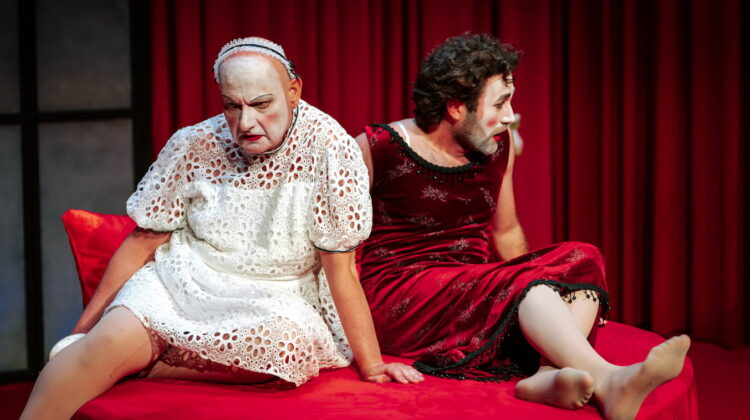
Victor De Bono and Anton Saliba in The Maids. Photos: Justin Mamo
Jean Genet’s The Maids was wonderfully scandalous when written back in the 1940s. It was based on a real-life story, the Papin sisters’ particularly gruesome murder of their mistress and her daughter. Even before true crime podcasters discovered just how lucrative the genre is, the notorious case became associated with Genet’s darkly provocative tale that spans absurdism, surrealism and satire.
The question is – has The Maids retained its relevance in a world where the servant-mistress dynamic described in the original script has perhaps taken on a very different hue? And if so, does Adrian Buckle’s and Victor De Bono’s co-production succeed in making Genet’s unsettling exploration of privilege and resentment resonate with a contemporary audience? First off, some details.
Table of Contents
The Maids details
| Play | The Maids |
| My Rating | ⭐⭐⭐ ⭐ (4/5) |
| Producers | Adrian Buckle and Victor De Bono |
| Script | Jean Genet |
| Translation | Martin Crimp |
| Director | Scott Le Crass |
| Cast | Victor De Bono, Malcolm Galea, Anton Saliba |
| Movement Director | Chakib Zidi |
| Stage Manager | Rachel Zammit |
| Assistant Stage Manager | Joanie Mifsud |
| Light design | Chris Gatt |
| Sound design | Alberto Garzia |
| Set design | Romualdo Moretti |
| Content warnings | Heavy psychological themes, death and violence |
| Running Time | 1.5 hours no interval |
| Dates | October 2,3,4,9,10,11 |
| Venue | Theatre Next Door |
| Language | English |
The Maids – the narrative
Genet’s The Maids sees the titular maids – Solange and Claire – indulge in a looping ritual where they role-play the murder of their mistress. It was widely viewed at the time as an allegory for class oppression and the corrupting nature of power. The Malta production is thankfully based on Martin Crimp’s English translation, rather than Benedict Andrews’ and Andrew Upton’s earlier version, which tried to take a shortcut to creating shock value via the liberal use of expletives.
Crimp’s translation is anything but crass. This version of The Maids is poetic in its approach, turning even the most repulsive phrases like “stagnant saliva” into sensuous invitations. In doing so, it manages to be more shocking than if Solange had suddenly started spouting the C-word.
The story itself is ridiculously simple, an almost continuous reloop of role-play and submission. In the background, we learn that Solange has shopped Madame’s lover to the police for theft, leading to his arrest. As the story unfolds we see each maid take turns to play the mistress, the fantasy reaching a climax with the latter’s murder. Only, they’re always interrupted by the real mistress’s arrival right before they manage to satisfy this urge. With each ritual, the fantasy spills more and more into reality until the audience is no longer quite sure whether they’re still play-acting.
The Maids – cast
Genet originally intended the roles of both maids and Mistress to be played by men, and director Scott Le Crass – unlike many others before him – fulfils the brief with the specific goal of interpreting the work through a queer lens. The choice of cast is probably the strongest element of this production, with no weak links among the three actors, each adding to the simmering tension and psychological volatility demanded by the script.
Of the three, Anton Saliba is particularly magnificent, the role of Claire requiring continuous shifts of personality. He’s shockingly cruel as the Mistress, but vulnerable and submissive when Solange turns on him during the ritual. Five minutes later we see his susceptibility to Madame’s superficial kindness. Claire’s final act is one of self-destruction, but also one that allows her to grasp back control. Ultimately, the impact of the ending depends on how convincingly Saliba brings together these conflicting impulses, and he balances this power play beautifully, with nuance, holding the audience in his grasp.
Victor De Bono is also impressive as Solange. The danger with this specific role is turning the maid into a basic bitter servant, whereas the character is a lot more complex than that. De Bono navigates this psychological depth with skill, creating tension between the outwardly aggressive dialogue and Solange’s simmering insecurity through expressive control that hints at the turmoil beneath her bravado.
Malcolm Galea has the least stage time as Madame, but this is the role around which the entire psychological drama unfolds so it’s no less demanding. Galea’s portrayal captures the character’s superficial kindness, unconscious condescension and genuine vulnerability without turning Madame into a pastiche (something Genet had actually warned against in his notes). Galea delivers his insults with measured precision, their cruelty all the more effective for his seeming obliviousness to the offence they cause.
Direction
Director Scott Le Crass is less consistent in his approach. He succeeds in introducing a queer undercurrent to the sisters’ relationship, with the sensuality of their interactions blurring the boundaries between familial intimacy and erotic desire. Yet I felt there was a missed opportunity to fulfil the director’s stated ambition to explore kink through the lens of shame and the need for escape.
The sadomasochistic dynamic is unmistakable, but the deeper associations remain elusive. I’d have liked to see more of the psychological conflict underpinning these rituals, particularly the tension between the freedom offered by fantasy and the internalised shame Le Crass identifies in the programme note.
Set, lights and music
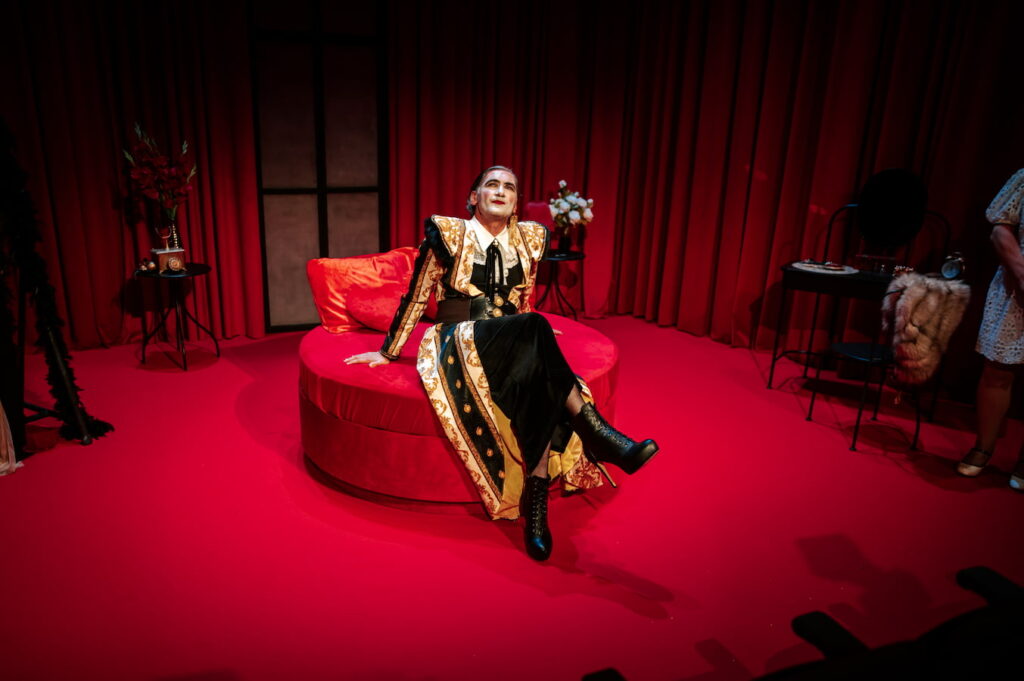
Romualdo Moretti is fresh from a superb set for Ħobżna ta’ Kuljum. Here, he creates a claustrophobic bedroom/boudoir, making excellent use of height to accentuate the sense of confinement. Credit also goes to movement coordinator Chakib Zidi, who ensures that the actors never appear cramped, but rather forced into an intimacy from which there is no escape. Zidi has become quite the name to watch out for, his contribution to productions like Il-Każin tal-Imqarbin and Peer Gynt never disappointing.
Chris Gatt’s lighting is equally effective (again, no surprise here), with impeccably timed cues that heighten the drama, especially during the opening scenes. Albert Garzia’s sound design maintains a subliminal undercurrent of tension, its presence felt even when we are barely conscious of it.
The Maids – verdict
A very solid interpretation of Genet’s classic, with a few missed opportunities that do little to diminish its overall impact. I left the theatre my mind in a whirl, unable to stop thinking about how the symbolism in The Maids has taken on new meanings in contemporary society, where the inequalities once embodied by the maid’s uniform continue to show themselves in gender-based struggles.
A successful production, particularly suited to those who enjoy theatre that challenges their assumptions and leaves them questioning long after the curtain falls. I’m also hopeful that this is a return to the type of productions I associated with the glory days of Unifaun Productions, when we saw challenging plays such as The Pillowman and Mercury Fur coming to the local stage. More of this, please and thank you.
Affiliate/Advertising Disclaimer: How I Carry Out Reviews
I received no payment for this The Maids review and I was offered press tickets. The opinions expressed here are purely my own and the producers had no input/control over what I wrote. There are no affiliate links contained within this page.To learn more about my policies and my reviewing process, visit my Affiliate/Advertising disclosure page. To better understand what the my rating means, check out the details of the star system.