

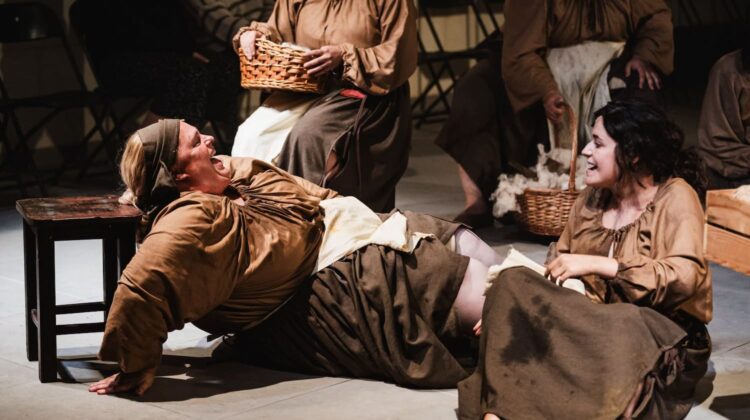
Ġimgħa l-Ħabs. Photo – Teatru Malta / Facebook
Teatru Malta’s Ġimgħa l-Ħabs brings the promising, strong voice of an emerging script-writer to the Maltese stage. Last year, Chantelle Micallef Grimaud won the Studio Francis Ebejer grant with her proposal for a narrative that centres around a week in the life of nine women who are imprisoned for various offences. The result is a production that, upon a cursory read of the blurb, was giving Orange Is The New Black. The actual experience, however, presents a powerful social commentary that goes beyond entertainment or even simple historical accuracy.
Table of Contents
Ġimgħa l-Ħabs production details
| Play | Ġimgħa l-Ħabs |
| My Rating | ⭐⭐⭐⭐ (4/5) |
| Producers | Teatru Malta |
| Script | Chantelle Micallef Grimaud |
| Direction | Chiara Hyzler |
| Cast | Monique Dimech Genuis, Magdalena Van Kuilenburg, Antonella Mifsud, Ilaria Costa, Sandie von Brockdorff, Charlotte Formosa, Michela Farrugia, Maya Sesay, Martina Schembri |
| Musical Compositions | The New Victorians |
| Production Manager | Rowena Zammit |
| ASM | Sara Gauci |
| Trigger Warnings | Themes of death and suicide |
| Age | 15+ |
| Running Time | 2 hours 30 mins, including short interval |
| Dates | July 3, 4, 5, 6, 7 |
| Venue | Mediterranean Conference Centre |
| Language | Maltese |
Ġimgħa l-Ħabs – the narrative
Playwright Chantelle Micallef Grimaud bases her work on research carried out at the national archives in Malta and London, and on one-on-one interviews carried out with a number of women who are currently serving prison sentences. The depth of her research comes across in each of the nine protagonists of the script.
From the first time we meet these women, it is immediately evident that this was not going to be a predictable journey into overly familiar themes. With a cast of nine characters there is always the risk that individual stories are turned into neat tropes. Here, each woman was written with enough depth to feel three-dimensional, each portrayed with her own contradictions and vulnerabilities.
This is not a short script, but the length is well-earnt. Micallef Grimaud gives the audience just enough exposition to immerse us into the world she’s built. Once the setting is established, the narratives unfold relentlessly, and often unpredictably. I walked in expecting a linear transition from one character’s arc to the next, which would probably have ended up being tedious across 2+ hours. Instead, Micallef Grimaud’s writing gives us bursts of confrontation juxtaposed with confessions and memories. The pacing is tightly controlled, with each story revealed in fragments rather than neatly packaged monologues.
Micallef Grimaud’s approach is reminiscent of that taken by Kim Dalli in last year’s production of Naħliflek, where Dalli also delved into court transcripts to add new detail to her translation of Breach Theatre’s It’s True, It’s True, It’s True. This level of research differentiates the strength of these two productions from other shows that were also based on historical happenings, but failed to convey the real lives behind the headlines. Throughout the process, Micallef Grimaud was mentored by author and playwright Clare Azzopardi — you may remember her from Tebut Isfar and Castillo. Ġimgħa l-Ħabs makes an excellent case for emerging voices to build mentorship into the dramaturgical process.
Direction, music & staging
The strength of the writing was matched by Chiara Hyzler’s direction. Ġimgħa l-Ħabs is the kind of play that can easily be tackled as a traditional narrative with decent, if unspectacular, results. Hyzler goes well beyond that, taking an almost multi-disciplinary approach that turns the space, soundscapes and movement into integral components of the story-telling to surprising effect.
The play is staged at the Mediterranean Conference Centre’s Sala Ospitalieri, the underground chamber almost making the audience feel actually incarcerated. Hyzler makes the most of the natural space, the tiny window hewn in the building serving as a symbol of freedom and offering the prisoners occasional glimpses into the world they were being denied. Maria Rosa Thornhill’s set works on two levels, with the beds fixed in the background serving as a constant reminder of the prison setting. The foreground shifts from a work area, to church pews and other spaces in the women’s lives.
One of the strongest directorial choices is the handling of the suicide scene, which is staged with control and poignant poetry. As the women kneel at the church pews in the foreground, the final pew becomes a transitional space that pulls us back towards what is happening in the background.
Hyzler has an excellent track record in juxtaposing horrifying scenes with other mundane happenings to powerful effect. The sexual grooming scenes in Dù Theatre’s 2025 production of Kif Tgħallimt Insuq are one such example. In Ġimgħa l-Ħabs, the technique takes us from moments of pure despair to tenderness, anger and even joy, with barely any transition time. The emotional roller-coaster keeps the audience from getting too comfortable, ensuring that the significant moments land with impact.
The score by the New Victorians complements the shifting moods beautifully. At times the crescendo intentionally jars with the events unfolding on stage, heightening the unease instead of simply providing accompaniment. At others, the soundscapes adds a sense of beauty to the more dramatically static parts.
Pamela Kerr’s lighting design contributes considerably to the drama of the space, albeit not without some unfortunate effects. The use of strong backlighting at several points may have been effective in creating silhouette and depth, but it also results in shining a series of spotlights directly into the eyes of the audience.
A final note about the intimacy of the space. The powerful acoustics heighten the production’s impact, but there are moments — particularly during the more emotionally intense passages — when the sound becomes uncomfortably overpowering.
The cast
The nine-strong cast of actors are all formidable, no exceptions. Some highlights, starting with Monique Dimech Genuis in the role of Maddalena Mallia, the noblewoman who spends the titular week in prison. Dimech Genuis uses her time on stage to portray a powerful, and believable, transition of personality. We see her shift from a frightened woman who clearly has nothing in common with her fellow inmates into someone no longer scared of voicing her opinions and giving them agency.
Michela Farrugia reveals an extraordinary voice. Her għana sequences are another form of testimony, far stronger than mere musical interlude. The strength of her interpretation is a clear indication of what Farrugia can achieve when supported by a script of substance.
Magdalena van Kuilenburg emerges as another strong presence within the cohort of women. Feisty and confident at the start of the play, she gradually reveals her overwhelming fear of the dangers brought about by her failing eyesight. The scene where she inadvertently upsets a bucket of drinking water is one of the most emotionally taxing in the play.
Sandie von Brockdorff delivers a heart-breaking portrayal of a woman hollowed out by grief. The first part of the play sees her kept almost at the margins, her presence registered through the occasional sounds of crying. Gradually, she brings her story into focus, emerging from the sidelines to reveal fragments of a once-beautiful life. The simplicity of the joys she had imagined for herself and her family is rendered all the more devastating by the final scene and the sense of waste it brings with it. We’ve already seen von Brockdorff’s capacity for dramatic roles in 1881 and My Name Is Rachel Corrie. Here, the approach has been refined, rendering it even more effective.
Ġimgħa l-Ħabs – the verdict
In spite of the difficult themes it tackles, Ġimgħa l-Ħabs is ultimately a portrayal of hope and strength. The play brings all the feels without sugar-coating the harsh realities of the themes it tackles. It acknowledges the social injustice and gender inequalities that were rife in the 19th century, while maintaining emotional and narrative momentum, and even bringing in touches of humour. No easy task, but one that cast and director pull off excellently.
The result is unexpectedly heart-warming and — equally importantly — entertaining. Ġimgħa l-Ħabs is that rare theatre beast, a deeply affecting production that finds wit and resilience in the most unlikely of places. For another deeply affecting experience, check out my review of 5Subien.com.
Affiliate/Advertising Disclaimer: How I Carry Out Reviews
I received no payment for this review of Ġimgħa l-Ħabs, and I was offered press tickets. The opinions expressed here are purely my own and the producers had no input/control over what I wrote. There are no affiliate links contained within this page. To learn more about my policies and my reviewing process, visit my Affiliate/Advertising disclosure page. To better understand what my rating means, check out the details of the star system. Check out my latest writeup: Cagliostro & The Pirate Queen: The Secret Story of Malta.