

Photos by Elisa von Brockdorff
A critical analysis of the exhibition at Spazju Kreattiv.
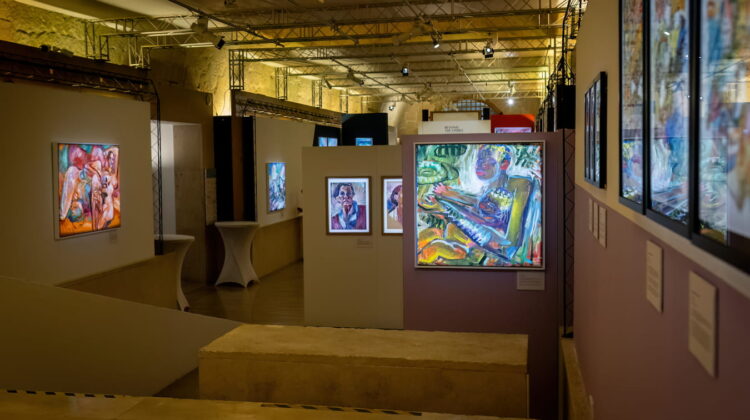
Taking up the main space at Spazju Kreattiv right now is the colourful world of Olaug Vethal, a Norwegian artist who spent much of her lifetime living and working in Malta. The exhibition, titled Beyond the Visible: The Metaphysical Worlds of Olaug Vethal, is curated by Christine Xuereb, and it offers a refreshingly unexpected perspective of the island. The artist’s flights of fancy gift the viewer with a kaleidoscope of portraits and landscapes that are not limited by conventional form, but take flight into a dreamlike world of shifting colour and visual language.
Table of Contents
Olaug Vethal’s journey into a personal Malta
Olaug Vethal viewed Malta differently from most of us. For her, the island represented a richness of music, myths, seascapes and a distinctly Mediterranean subconscious. Through her eyes we rediscover a Malta that many of us – in the midst of daily drudgery and an abyss of concrete – have sadly forgotten how to find. Not Vethal, who digs deep in the most mundane of landscapes or activities to find the soul and beauty within.
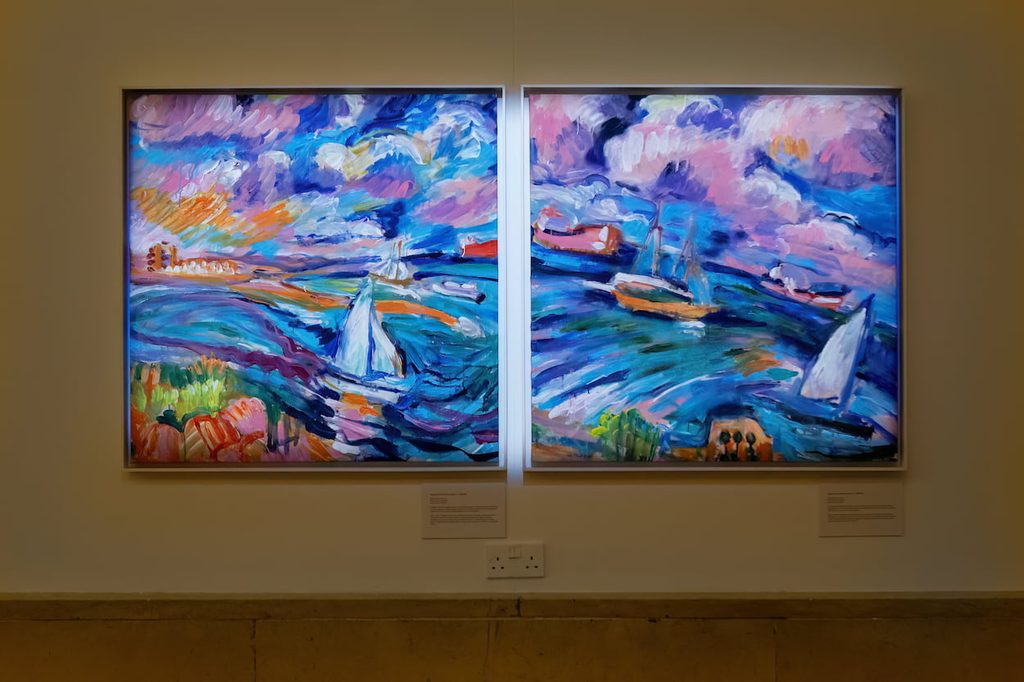
A simple coastline is never a simple coastline, as Vethal’s painterly approach dons it with an emotional charge that pushes it beyond representation. This treatment is present in every collection that forms part of Beyond the Visible: The Metaphysical Worlds of Olaug Vethal. The works revolving around the Malta Jazz Festival are an enchanting example, with musicians seemingly melded to their instruments in abstract swirls of colour that create a sense of urgency and intensity. Absorbed in this energy, the viewer is no mere observer, becoming part of the emotional and visual rhythm that unfolds on the canvas.
Grasping the metaphysical
As the name of the exhibition suggests, the metaphysical is ever present, and nowhere more so than in Vethal’s collection of Japanese-inspired works. Here, the Asian influence goes beyond functioning purely as reference and becomes absorbed into Vethal’s own visual language. Flattened planes, elongated features and an almost calligraphic freedom of line loosen the figures from straightforward representation, allowing them to hover somewhere between portrait and psychological state.
I was particularly taken by Vethal’s focus on the human figure. Even here, the body is not represented as a mere vessel, taking on the role of vehicle for emotional experience. What makes these works particularly remarkable is that, while Vethal appears to be disinterested in accurate anatomic accuracy, the figures remain recognisable. Lines fold within each other, colours spilling over from one figure to the next so as to make the self almost fluid. The corporeal flirts with the elusive so that no single body is ever self-contained.
The same treatment is reserved for the sea, where Vethal dispenses almost entirely with the postcard Mediterranean we’re familiar with. Rather than scenery, this most integral aspect of our island’s identity is transformed by the artist’s brush into a sensation. Colour surges across the canvas and forms dissolve to reveal a landscape that seems caught in perpetual motion. Again, the impression as a viewer is that I’m being carried through the experience rather than simply looking at a painting of the Maltese coastline.
Vethal turns the gaze inward even for her series of self-portraits. The physical likeness is but a point of departure, as colour and distortion prise open the face to reveal that which is less accessible: consciousness, instability, perhaps even the impossibility of fixing the self in a single image.
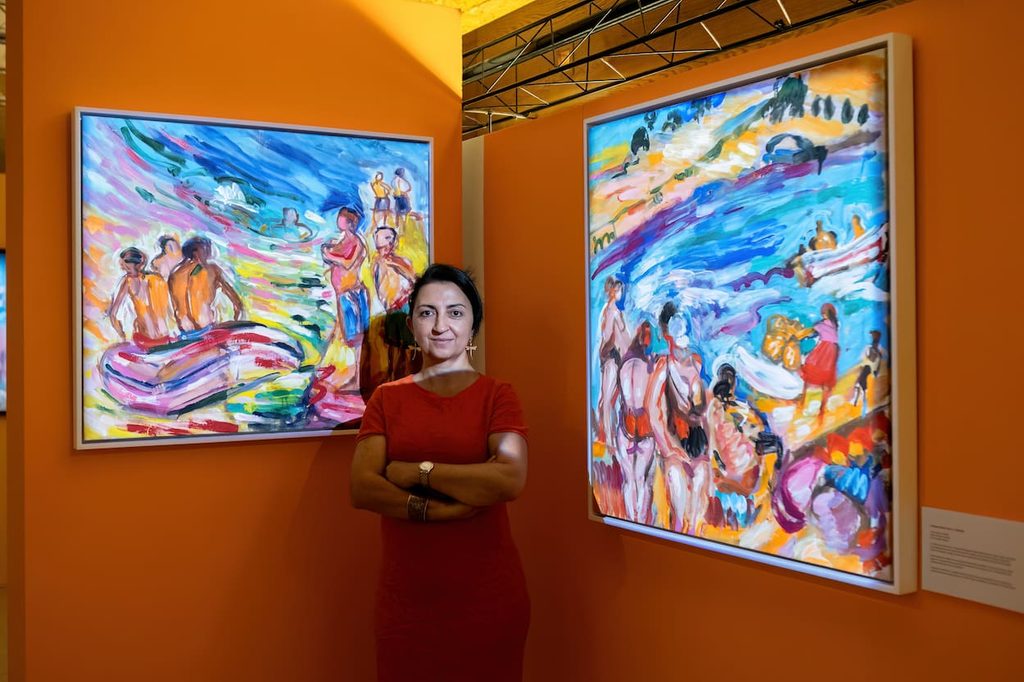
Christine Xuereb, curator of Beyond the Visible: The Metaphysical Worlds of Olaug Vethal.
A curatorial approach that holds these worlds together
Christine Xuereb takes an effective curatorial approach, giving Olaug Vethal’s many preoccupations room to breathe without allowing the exhibition to become fragmented. Works are grouped thematically — self-portraits and studies of the human figure in one area, Japanese-inspired pieces in another, seascapes elsewhere. This creates a natural visual pathway through the space while still allowing connections to emerge between sections.
The approach works because it does not fall into the trap of a rigid chronology, as is so often the case with posthumous exhibitions. Xuereb treats the works as a map of Vethal’s imagination, each grouping revealing a different facet of the same restless visual language.
Finding the jazz-inspired collection at the back of the space provides an especially satisfying culmination. Here, the curatorial decision to introduce music from the festival adds another sensory layer without overwhelming the paintings, reinforcing the movement and improvisatory energy already present on the canvas. The works almost become the arrival point, where sound, colour and strokes converge and the exhibition’s themes of movement, memory and lived experience are brought vividly together.
Outside of the works themselves, this is perhaps the exhibition’s greatest achievement. It doesn’t attempt to explain Vethal, but it allows us, briefly, to inhabit Malta in the way she saw it.
Beyond the Visible: The Metaphysical Worlds of Olaug Vethal runs at Spazju Kreattiv’s Space A until October 25. It is curated by Christine Xuereb and entrance is free. For those who are not able to physically attend the exhibition, the works can be viewed via this Artsy.net link.